The way information flows in the tech industry has undergone a structural transformation. Fifteen years ago, a startup founder seeking credibility and reach had a predictable playbook: try to get featured in TechCrunch, secure a profile in Forbes or the Wall Street Journal, and speak at a major conference like TechCrunch Disrupt. Those legacy outlets conferred validation (“as seen in WSJ”) and had broad, if not targeted, reach. The “water cooler” conversations in tech were often reactions to pieces in Wired, Fortune or the New York Times. Traditional business journalists acted as moderators of the narrative, and having their ear was crucial for VCs and PR teams.
Today, in 2025, much of that has flipped. The locus of reputational leverage and distribution has shifted to direct channels and creator-led platforms. Founders now build credibility through Twitter (X) threads that showcase their vision, Substack newsletters that demonstrate expertise, and appearances on insider podcasts or YouTube shows that are popular among peers. If 2010 was about “have you been covered by TechCrunch?”, 2025 is about “have you been on TBPN or mentioned by All-In?”. The casual online chatter (“water cooler” talk) that shapes opinions happens on X and in podcast banter far more than in the comments of news sites. For instance, when a scandal or trend hits, tech insiders often discuss it on Slack groups or Twitter Spaces, not waiting for the next morning’s FT article. Even major CEOs address issues on social media or company blogs before talking to press. The result is that the timeline (Twitter feed) and the podcast queue have become the de facto front page for the tech community.
This is the approach insights4vc helps funds and portfolio companies build.
We combine research-led positioning, founder narrative, launch support, content production and distribution strategy for teams that need to make a market understand why they matter. To discuss a tailored New Media support program, contact us.
The a16z New Media Thesis
Andreessen Horowitz’s “What is New Media?” essay (Nov 2025) lays out a framework for how tech and venture capital should approach media in the 2020s. At its core, the thesis argues that the traditional boundaries between venture firms, founders, and the media have blurred. Just as a16z disrupted venture by providing services beyond capital (e.g. recruiting, marketing), it now sees providing narrative and distribution as part of a VC’s job. In a historical parallel, a16z invokes the founding of CAA in 1975, when Hollywood agents empowered talent to bypass studio gatekeepers. Likewise, today’s “legacy media and legacy distribution” in tech can be bypassed since anyone can go viral on social platforms, but founders need sustained narrative momentum. A16z posits that a modern VC should help entrepreneurs build that momentum directly, rather than relying on third-party outlets. In short, “own your distribution; or better yet, use ours” is the mantra.
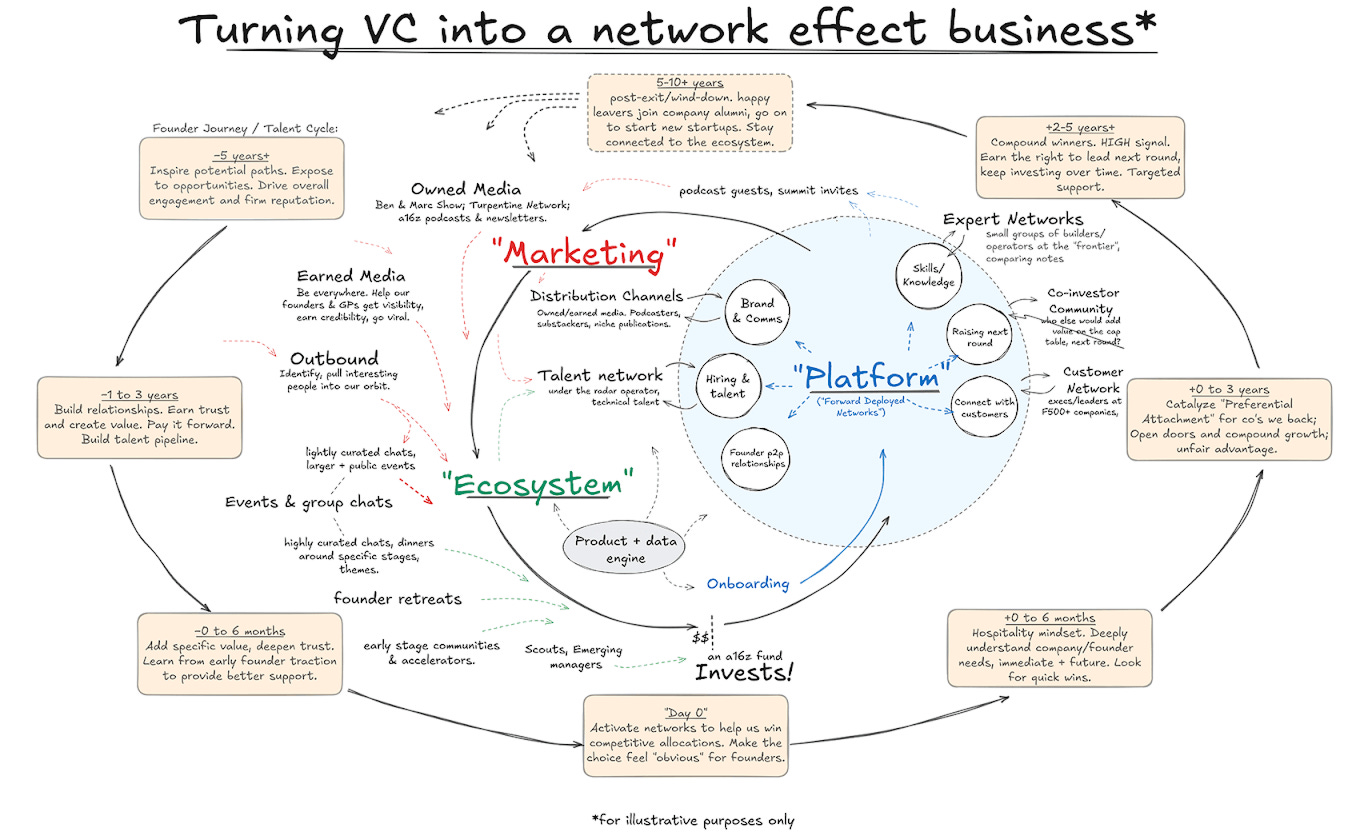
New Media vs. Legacy Media (a16z’s view)
The essay frames legacy tech media as an “old guard” of gatekeepers that package the tech narrative for a broad audience (often with skepticism or sensationalism), whereas “New Media” is aligned with founders and builders, speaking in their language and on their turf. Legacy business outlets like Bloomberg, WSJ, FT, Forbes, The Information, and others are portrayed as serving a general business readership and operating on slower cycles with adversarial journalistic norms. A16z’s New Media, by contrast, is unabashedly “founder-friendly” and fast-paced, meeting the audience on platforms like X (Twitter), YouTube, and podcasts where the conversation is happening in real time. The firm explicitly pitches that storytelling, hype, and community-building are now part of the product and go-to-market stack for startups, not a glossy afterthought. In this view, distribution is “too important to outsource” and should be treated with the same rigor as product development. The ability for a founder to “win the internet for a day” (for example, with a viral launch) can translate to tangible business wins: talent recruited, users signed up, investors interested. Thus, a16z is building an in-house media machine to systematically deliver those wins. This reflects a broader trend: narrative has become a key battleground for tech companies, so much so that some VC firms are willing to become media companies themselves to secure an advantage.
by a16z
Historical context – from podcasts to a full media arm
A16z is not new to media; it has experimented for over a decade. Back in the 2010s, a16z’s early content efforts like the a16z Podcast (launched in 2014) and a content site (eventually Future.com around 2020) signaled the firm’s belief in publishing useful analysis for the tech community. The a16z Podcast, under editor-in-chief Sonal Chokshi, became a respected outlet featuring partners and guests dissecting tech trends, at one point reaching millions of downloads. However, those early efforts were relatively traditional: a weekly podcast, long-form blog posts, and newsletters that, while popular, mirrored the formats of standard media (just under the firm’s umbrella). There were also misses: Future, a digital magazine staffed with experienced journalists, attempted to compete with tech news sites but struggled to find a unique voice and was eventually folded back into a16z’s main content platform by 2022. These experiments taught a16z what works (authentic voice, partner-led discussions, direct distribution) and what does not (expensive newsrooms without a clear “edge”).
What is different now is the formalization and scale
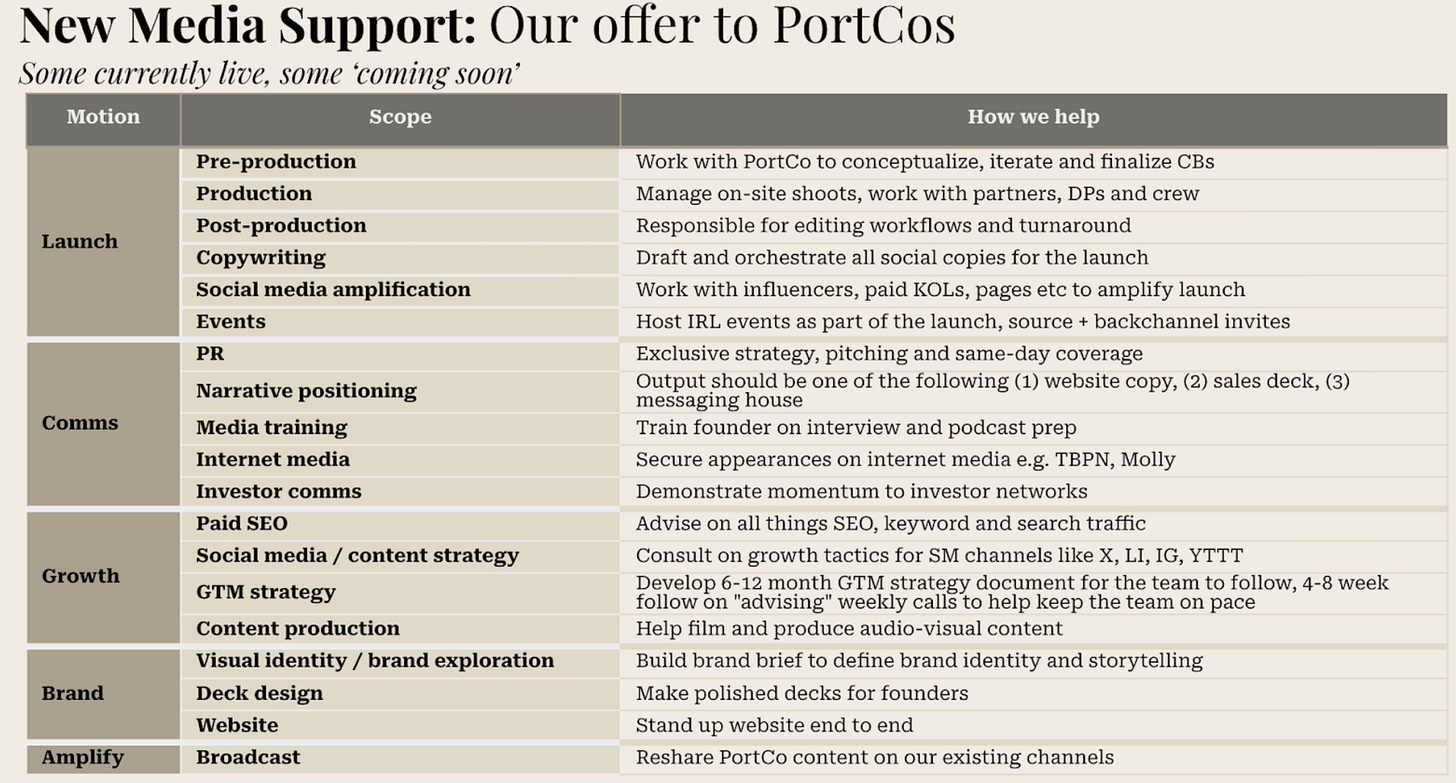
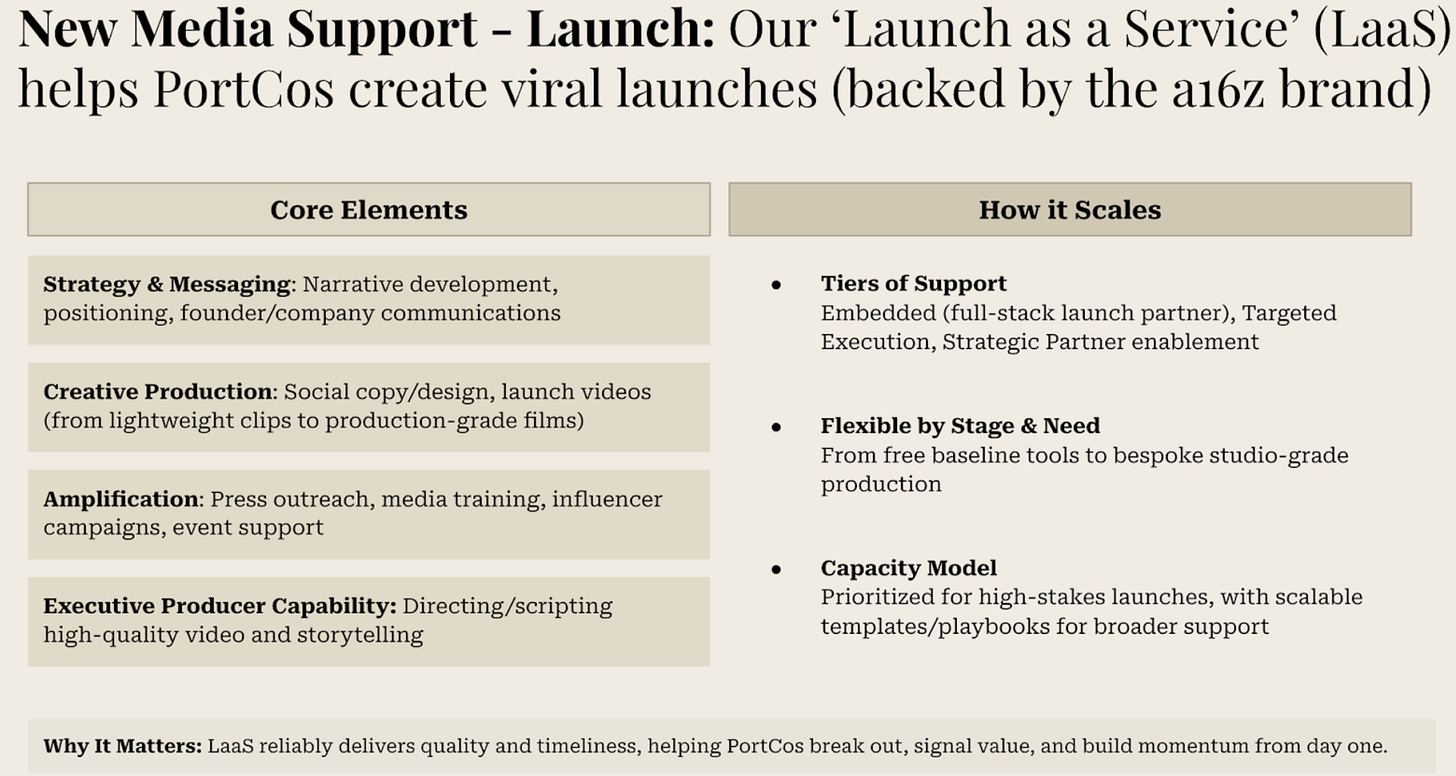
In mid 2025, a16z created a dedicated New Media team and announced an eight-week New Media Fellowship to train operators and storytellers, starting January 2026. This goes far beyond a marketing team; it is a full stack media operation inside the firm, with a mandate akin to a production studio plus news outlet plus PR agency combined. The fellowship implies a pipeline of talent fluent in tech narrative who can be “embedded” in portfolio companies (a concept a16z calls “forward-deployed New Media”). By training fellows and then placing them as storytellers inside startups, a16z aims to propagate its approach across its entire portfolio, achieving leverage that scales even beyond what the in-house team can do. This is a marked shift from earlier “content marketing” approaches: it treats narrative expertise as a talent to recruit and invest in, similar to how firms cultivate technical advisors or entrepreneurs-in-residence.
by a16z
by a16z
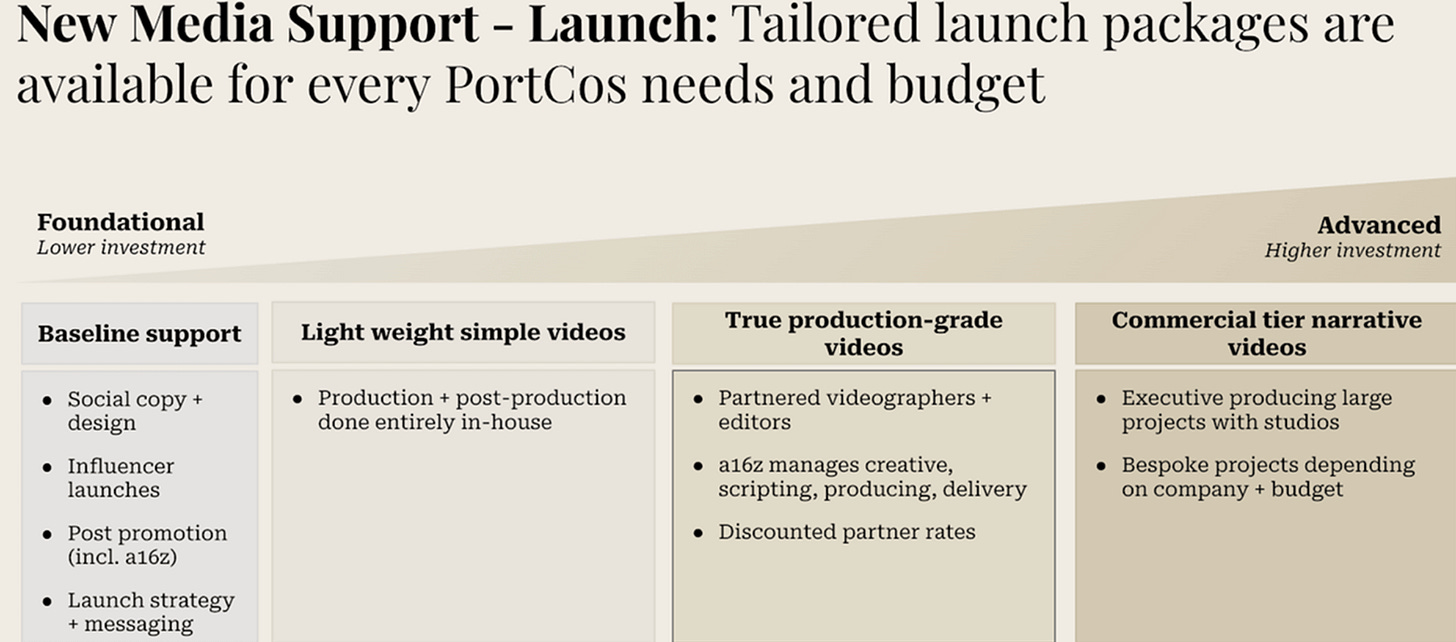
Mapping the New Media stack
Implied by a16z’s strategy is a reproducible stack of capabilities:
- Origination (Talent): Content creation starts with people. A16z has assembled an internal crew of what it calls “online legends” – notable tech storytellers and power users of social media. For example, the essay’s contributors include Erik Torenberg (founder of media projects like On Deck and Turpentine network) and Alex Danco (a sharp tech essayist) as full-time hires. By mixing investors, operators, and professional creators, the team generates content that is both deeply informed and platform-native. Additionally, external creators are part of the mix: via the fellowship and ecosystem programs, a16z taps rising bloggers, YouTubers, and podcasters, giving them a platform in exchange for alignment with the a16z universe. In effect, a16z is building a bench of content talent much like a media company would cultivate journalists or influencers.
- Formats: The New Media initiative spans a range of content formats, often integrated for maximum impact. A16z’s owned channels now include a daily podcast (the main a16z Podcast scaled up to 5 episodes per week) and a daily newsletter, both intended to be “habit-forming” for the tech audience. They produce long-form essays, short-form videos tailored for virality on X and YouTube, conference-style events like their “Runtime” summit (for which they do first-party video production), and live audio discussions (Twitter Spaces or similar). Crucially, a single narrative push might involve several formats at once: for example, a startup launch could come with a sleek video, a companion podcast interview with the founder, an essay by the lead partner, and a storm of tweets amplifying it. This multi-format approach acknowledges that tech audiences are fragmented across platforms; meeting them everywhere multiplies the impact.
- Distribution: A16z leverages both its own distribution and external platforms to spread content. The firm’s social reach is massive (many partners have large followings, and the a16z main X account has hundreds of thousands of followers), which provides an immediate audience. The philosophy “own your distribution” is taken to heart: a16z does not depend on media coverage of its announcements; it breaks news on its own blog and social feeds. They syndicate content via Substack (where a16z has a newsletter hub), YouTube (for video series and event footage), LinkedIn (targeting a professional audience), and direct email. The daily repetition (podcast and newsletter every weekday) is designed to algorithmically and habitually favor a16z content, an attempt to occupy share of mind continuously. As the essay notes, “it takes a lot of work to make it look easy” in growing an audience, and a16z’s team is explicitly focused on craft: SEO, editing for social media, developing a house style for visuals, and so on. An example cited is a short animated clip of Marc Andreessen explaining a concept, which performed well due to thoughtful editing and design. By mastering these distribution techniques in-house, a16z avoids reliance on external PR agencies or media outlets to reach tech audiences.
- Feedback loop into venture: Perhaps the most intriguing part of a16z’s New Media thesis is how it loops back into the core venture business. Success in media is not just measured in impressions, but in preferential deal flow. By “winning the timeline” with content that founders consume, a16z increases its chances of being top-of-mind for the best entrepreneurs. The essay explicitly states one goal: “help the next cohort of great founders… preferentially attach to our portfolio companies – and to a16z itself.” In practice, this means if a16z’s content consistently provides value or entertainment, founders will feel aligned with the firm before they even raise money. There is anecdotal evidence of this industry-wide: for instance, founders who are avid listeners of podcasts like Acquired or All-In often build a rapport with those hosts (who are investors) long before any formal pitch. A16z is systematizing that effect. Moreover, the New Media team’s services to portfolio companies (for example boosting a product launch) directly improve those companies’ outcomes, which can increase their fundability and growth, ultimately benefiting a16z’s investments. This “media as a service” for portfolio support is a novel value-add: a16z suggests it can deliver a founder’s message to millions in a coordinated blitz, something a traditional VC marketing team or a PR firm might struggle to do on short notice. The feedback loop is reinforced by community-building too: the New Media team hosts high-trust events, group chats, and dinners to connect founders and talent. These offline or semi-private networks deepen loyalty to a16z’s ecosystem, which again feeds into more deal flow and stronger portfolio companies.
by a16z
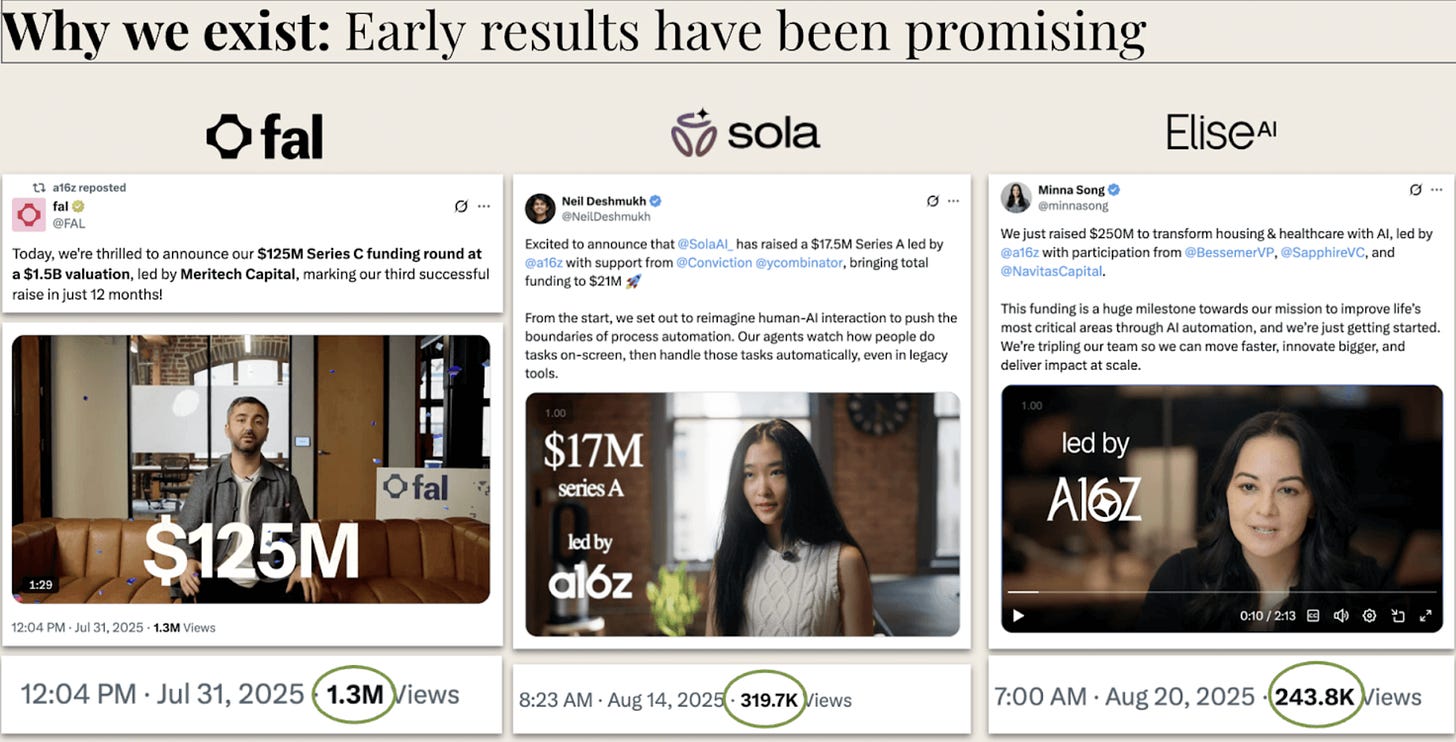
Incentives and power dynamics
By owning a media channel, a16z aligns incentives between storyteller and subject in a way legacy media cannot. Traditional journalists serve their readership and standards of objectivity, which can put them at odds with founders or VCs seeking a favorable spin. In the New Media model, the storyteller (a16z or a sympathetic creator) and the subject (founder) share the goal of celebrating technology and pushing the narrative forward. This realignment of incentives is powerful: it means founders may prefer to tell their story on an a16z podcast or via an allied creator because they expect a more understanding treatment. Over time, this could bypass the need for a press tour in legacy outlets. However, it also raises the question of independence and credibility. A16z’s content is forthrightly promotional of tech’s upside, something the firm does not hide. The bet is that the target audience (builders and tech enthusiasts) prefer that tone to what they perceive as the cynicism or misunderstanding in mainstream coverage.
This dynamic subtly shifts power. Venture firms and founders gain more control over narrative, whereas journalists lose some exclusivity in setting the agenda. For example, when a major story breaks (say a controversy at a startup), legacy media might investigate and publish exposés, but now the subjects can respond or preempt on their own channels. A recent anecdote: when a multi-job fraud scandal emerged in Silicon Valley in 2025, tech Twitter eagerly awaited the person’s interview on TBPN rather than a New York Times piece.
The broader market response
A16z may be ahead, but other venture firms are moving in the same direction. Many top firms have beefed up their content and marketing teams in recent years. Sequoia Capital, for instance, publishes extensive founder stories and has a content arm producing insights; Lightspeed Venture Partners has active blogs and video series featuring its partners. Several funds launched podcasts (often interview shows with portfolio founders or other VCs). However, most of these efforts remain ancillary, for example a monthly podcast with modest listenership, essentially modern versions of firm newsletters. What a16z is proposing (and already executing) is much more intensive: daily production, a dedicated headcount similar to a newsroom, and the ambition to build a media brand in its own right. It is the difference between a hobbyist approach and an industrial approach.
Some funds have chosen to partner with independent creators rather than build in-house. For example, VC firms often sponsor popular tech newsletters or podcasts (without controlling them) to get brand exposure. A16z itself has invested in media platforms and supports creators indirectly. But the New Media thesis suggests that merely sponsoring content is insufficient; the real advantage comes from vertical integration, that is, the VC firm runs the show. In doing so, they can ensure the content aligns perfectly with their ethos and objectives, something that an external media asset might not guarantee.
TBPN as a Live Case Study of the New Playbook
The Technology Business Programming Network (TBPN) exemplifies the new media playbook in action, independent of any single VC firm. It is an archetype of a creator-led, founder-friendly media property that has rapidly become a fixture in tech.
Origins and format
TBPN’s genesis is telling. In October 2024, two longtime friends in tech, John Coogan, co-founder of Soylent, and Jordi Hays, a fintech founder who sold his startup to Rho in 2023, decided to “riff on the week’s tech news” in a YouTube livestream. Coogan was not starting from zero as a media operator. Before TBPN, he had built a personal YouTube channel to more than 450,000 subscribers, producing polished, news-driven videos on technology, business history, startups and Silicon Valley. That earlier channel gave him a practical understanding of audience growth, packaging, editorial cadence and the mechanics of internet-native distribution. TBPN was the next step: less algorithm-chasing, more intentional programming for the people shaping tech.
They dubbed the show “Technology Brothers” with tongue-in-cheek bravado, poking fun at the “tech bro” stereotype by literally branding themselves as brothers. Early episodes were casual and unpolished, built around T-shirts, couch commentary and loose founder banter, but within weeks the duo saw demand and ramped up production. By late 2024, they rebranded the show as TBPN, an intentional nod to cable networks like CNN or ESPN but for tech, and committed to a daily live format.
Today, TBPN streams live every weekday at 11am–2pm Pacific, with Coogan and Hays as the constant hosts and a rotating cast of guests. Each show is simultaneously broadcast on X (Twitter) via live video and on YouTube, and later released as an audio podcast and a written recap via their newsletter. In essence, it is “technology’s daily show,” the equivalent of a daily news channel produced by a lean startup team.
A typical TBPN episode blends several segments to keep things moving: the hosts discuss breaking tech news or a big trending topic (often pulling up articles or tweets on screen), they do live interviews with startup founders and venture capitalists (generally around 15 minutes each) in a kind of rapid-fire parade, and they banter about market rumors or “inside baseball” Silicon Valley chatter. The live guest interviews are a defining feature. It is common for 4 to 6 guests to appear in a single three-hour show, sometimes even up to 10 on special theme days. For example, on a defense-tech themed day, TBPN might line up a series of CEOs from new defense startups, effectively turning the show into a launchpad for announcements.
This high-cadence, unedited interview style is reminiscent of call-in sports radio or CNBC, but tailored to startups, where a founder dials in via Zoom to talk about a funding round or product release in a friendly chat. The key here is immediacy: TBPN reacts to news in real time and integrates itself into the news cycle. If a major tech story breaks in the morning, Coogan and Hays will likely be discussing it, or even talking to someone involved, by that same midday on TBPN.
Importantly, the hosts are founders and insiders, not journalists by training, and they do not pretend to be objective reporters. As Hays put it, they see themselves as “digitally native news anchors” for the tech community. This means the tone is conversational and at times cheerleading. The show aims to celebrate tech innovation and poke fun at the tech scene’s quirks, rather than investigate it critically. Both Coogan and Hays have skin in the game, they angel invest and advise startups, and they openly network on the show. The audience, largely composed of startup employees, founders, and VCs, seems to appreciate this angle. Watching TBPN feels like being in a very informed group chat or a clubhouse room, rather than a polished PR event.
Editorial stance and community
TBPN has been described as “SportsCenter for tech,” and that captures the vibe. Much like a sports commentary show thrives on insider jargon, highlights, and passionate opinions, TBPN creates a similar in group feeling for techies. Coogan and Hays frequently reference memes or Twitter jokes that only plugged-in listeners would get, creating that “if you know, you know” appeal.
One example is an X user joking that “none of the men posting these have the courage to call Coogan and Hays hot outright… which is what we’ve been missing in tech podcast hosts,” a tongue-in-cheek fan commentary that the hosts gleefully acknowledged. This kind of meta-humor, fans commenting on the hosts and the hosts amplifying it, fosters a sense of community and belonging.
The show’s content mixes serious and playful. On one hand, TBPN has broken real news: founders have used it to announce fundraises or product launches before they hit the press. For instance, the CEO of Poseidon Aerospace appeared on TBPN the day after launching out of stealth, as a way to immediately reach the core tech audience. In doing so, the show acts as a direct distribution channel for startup news, a role traditionally played by outlets like TechCrunch.
On the other hand, TBPN does not shy away from informality: the hosts give unvarnished opinions on tech gossip, debate which startup ideas are overrated, and react live to things like Elon Musk’s latest posts or The Economist’s tech coverage. This blend, real news plus barstool commentary, makes the audience feel like insiders. Many founders and VCs have started to view a TBPN appearance or mention as a status symbol.
As one startup operator quipped on X, “I now only respond to VC cold emails if they’ve been on @TBPN… serious alpha,” to which prominent investor Alexis Ohanian replied in agreement. The hyperbole aside, it signals that TBPN has become a part of the tech community’s social proof mechanism. If a VC appears on TBPN, they signal they are “in the mix.” If a startup gets a TBPN slot, it shows they are tapped into the network. In this way TBPN functions as a new kind of gatekeeper or credentialer in Silicon Valley.
Economics and operating model
TBPN’s business is notable for its lean, venture-independent model. Coogan has stated they did not raise any venture funding to start TBPN and have no plans to, as they prefer independence. Instead, they run on an advertising-supported model, akin to a traditional media business but with a niche focus.
As of 2025, TBPN was already supported by a roster of high-value sponsors such as Ramp (a fintech platform), Figma (design software), Vanta (security compliance SaaS), Linear (developer tool), Eight Sleep (a smart mattress), Wander (luxury vacation rentals) and Bezel (watches). This advertiser mix skews heavily toward B2B tech, enterprise software and tools that startups use, with a touch of affluent consumer lifestyle, for example Eight Sleep’s expensive beds. It is a clear reflection of TBPN’s audience of tech professionals. Essentially, companies know that TBPN’s viewers are likely startup folks with budgets for SaaS and a propensity to spend on premium gadgets or experiences, which makes it an attractive niche for sponsors.
By April 2025, Coogan disclosed that TBPN had a small crew of editors and three full-time staffers besides the hosts. They were operating in a scrappy manner, for example using a basic studio setup in Los Angeles. Yet with that minimal staff they churned out over three hours of content daily, repurposed across streaming, podcast, and newsletter. This speaks to a key economic advantage of the new playbook: extremely high leverage of creative talent. Two charismatic hosts plus a handful of producers can generate a volume of content that would have required a whole newsroom or TV crew in legacy media.
The result is a high margin operation. By its first anniversary in fall 2025, TBPN was reportedly on track for 5 million dollars in annual revenue with only around 10 total employees. For comparison, legacy tech news outlets with similar revenue often employ many dozens of reporters, editors, and salespeople. TBPN’s revenue per head is an order of magnitude higher, indicating a lean cost structure.
The hosts have hinted at expanding the operation, for example signing a lease on a Hollywood soundstage to upgrade production quality. They also brought on a president - Dylan Abruscato, a seasoned media executive, specifically to grow ad deals, including moving upmarket to luxury brand sponsors in addition to software firms. Luxury advertisers, such as high-end auto or finance brands, are eyeing TBPN presumably because its audience includes well-paid tech investors and founders. If TBPN can successfully court such sponsors, its CPMs, ad rates, could rival mainstream business media, further boosting revenue without massively increasing audience size.
TBPN in the New Media framework
TBPN ticks virtually every box in the a16z “New Media” framework. It is creator-led, two personalities who are the brand. It is unabashedly founder-friendly, the show’s content often flatters tech culture and gives sympathetic platforms to founders with zero “gotcha” journalism. It is built around personality and community, fans refer to Coogan and Hays by first name and interact with them on X, and memes from the show circulate in the tech Twitter community, creating a feedback loop of engagement.
The distribution is multi-platform and optimized for virality. By being on X and YouTube live, TBPN benefits from algorithmic boosts and ease of sharing. Clips from TBPN frequently get reposted on social media by viewers, extending its reach at no cost. The monetization is via direct relationships: sponsors come on board to speak straight to TBPN’s audience, often with host-read ads that blend into the conversational tone, and TBPN’s eventual move into events or merchandise would similarly capitalize on direct fan affinity. There is no reliance on programmatic ad networks or third-party intermediaries. It is all high-touch advertising where advertisers are almost community members themselves, for example fintech CEOs who both sponsor and appear as guests, blurring advertising and content in a way legacy media would avoid.
TBPN is also becoming an emerging gatekeeper in tech. Already, startups strategize about getting on TBPN to launch a product or announce a funding round. Likewise, VCs vie for guest spots to boost their personal brand. This means TBPN, despite being informal, holds soft power in the ecosystem, since being on the show confers validation.
20VC (Harry Stebbings)
20VC is perhaps the cleanest example of a media asset compounding into a full venture franchise. Harry Stebbings started 20VC as an 18 year old in his bedroom in London, recording short interviews with VCs using a cheap microphone and a relentless cold email schedule to reach names that normally would not take a teenager’s call. Over time, the show evolved from “The Twenty Minute VC” into a daily, long form conversation series with many of the most powerful investors and founders in the world, effectively becoming a living rolodex of global venture. By the late 2010s, 20VC was already one of the largest podcasts in venture capital by audience, which meant that when Stebbings launched his first fund in 2020, he was not an unknown manager, he was the host of the media property a large part of the market already listened to.
On the capital side, the firm has scaled extremely quickly relative to its headcount. After an initial micro fund of roughly 8 million dollars raised in 2020, 20VC closed a pair of funds totalling 140 million dollars in 2021, split between an early stage and a growth vehicle. Limited partners included MIT’s investment office and RIT Capital Partners, signalling that institutional capital was willing to back a podcaster led franchise once the returns and access story was credible. In October 2024, 20VC announced a third fund of 400 million dollars, with 125 million earmarked for seed and 275 million for Series A, again backed by blue chip LPs such as MIT, Horsley Bridge and RIT. Public statements now put 20VC’s total assets under management at more than 600 to 650 million dollars, run by a team of fewer than twenty people, which makes it one of the highest leverage examples of the “media first, capital second” model in Europe. The podcast remains the top of the funnel, delivering daily exposure to founders and co investors, while the funds monetise that attention through concentrated stakes in early stage companies in Europe and the United States.
Project Europe is the logical extension of this thesis into nation building for European tech. Launched in 2025 together with Point Nine and Adjacent, and backed by more than one hundred and twenty prominent European founders, Project Europe is a 10 million euro vehicle that writes 200 thousand euro cheques to founders aged 18 to 25 in exchange for 6.66 percent equity. The offer is not only capital; cohorts get access to the 20VC media machine for distribution, plus a tight network of experienced operators who act as mentors and signal boosters. Stebbings has framed the initiative explicitly as an answer to Europe’s “doom loop” narrative and talent brain drain, arguing that Europe can and should produce the most important tech companies of the next decade. In the context of your New Media thesis, 20VC plus Project Europe show how a creator led media property can evolve into a vertically integrated platform: content at the top, fund structures in the middle, and targeted programs like Project Europe at the bottom that turn audience, story and capital into a pipeline of new companies, especially in geographies where traditional venture brands have dominated the narrative.
All-In Podcast (Chamath Palihapitiya, Jason Calacanis, David Sacks, David Friedberg)
The All-In Podcast was born in early 2020 as a weekly Zoom call among four longtime friends and investors. Its hosts include: Jason Calacanis, an angel investor known for his early bet on Uber and for hosting the tech podcast “This Week in Startups” since 2009; Chamath Palihapitiya, former Facebook exec turned venture capitalist (Social Capital) known for outspoken views; David Sacks, a PayPal Mafia alum and general partner at Craft Ventures who’s deeply involved in politics; and David Friedberg, a scientist-turned-entrepreneur (Climate Corporation) who runs an investment holding company. The chemistry among the “Besties” (as they call themselves) and their mix of domains (tech, finance, science, politics) propelled All-In from a niche experiment to one of the most downloaded tech podcasts. Episodes typically drop once a week (with occasional bonus episodes during big news weeks) and run 90 minutes to two hours, featuring the four hosts debating recent events. There are no guests on regular episodes - the draw is the hosts’ unfiltered takes and camaraderie.
Jason Calacanis’s prior media experience was instrumental. Through over a decade of hosting This Week in Startups (TWIST), Jason honed an ability to carry conversations and draw in an audience. TWIST gave him a base of loyal listeners and credibility as a commentator. That groundwork meant that when All-In launched, it piggybacked on an existing audience quickly. Moreover, Jason’s production know-how ensured decent audio/video quality from the start, unlike many amateur podcasts. Chamath, Sacks, and Friedberg each brought their own networks of followers as well. Chamath, for example, had a public persona from his high-profile SPAC deals and Twitter presence; Sacks was known in tech and increasingly in political circles; Friedberg, though less publicly famous, attracted those interested in science and climate. In combination, their networks overlapped with but also extended beyond the typical tech podcast fandom. This gave All-In a large addressable audience.
Markets, politics, tech, and summits
All-In’s differentiator is how seamlessly it toggles between technology discussions (like startup trends, macroeconomic impacts on tech) and political discourse. In doing so, it tapped into a zeitgeist: by the early 2020s, Silicon Valley’s elite were increasingly vocal on policy (especially around COVID, education, and later national politics). All-In became the venue where tech billionaires aired opinions on governance and society free from the filter of journalists. For example, during the pandemic, All-In episodes criticizing lockdown policies or teacher unions resonated with many in tech who felt mainstream coverage was one-sided. The hosts often joke and banter, but they also use the platform to push serious agendas (Sacks advocating for less U.S. foreign intervention, Chamath floating ideas on social programs, etc.). This ability to shape political narrative from a tech perspective is something new: historically, tech figures had op-eds or maybe Congressional testimony; now they have a weekly talk show reaching hundreds of thousands of voters and decision-makers.
All-In didn’t stop at audio. Recognizing their influence, the hosts launched the All-In Summit in 2022. These are multi-day, in-person conferences blending live podcast recordings with on-stage interviews and social events. The summits are deliberately exclusive: the 2022 inaugural summit in Miami was limited to ~700 hand-picked attendees, and by 2024 it scaled to ~1,950 attendees paying $7,500 each for a two-day event in Los Angeles. These summits feature high-profile speakers from tech and politics, for example Elon Musk, Florida Governor Ron DeSantis, and venture icons like Bill Gurley, making them part TED Talk, part political rally. Notably, the All-In Summit 2024 had figures like Peter Thiel and Senator J.D. Vance, underscoring the show’s emerging role as a bridge between Silicon Valley and the conservative political sphere. The Summits have become franchises of their own: they generate substantial revenue (well over $10M from tickets in 2024, plus sponsorships), and the content recorded there feeds the podcast, extending All-In’s reach. They also deepen the community aspect: fans (who call themselves “besties” after the hosts’ nickname) get to meet and network, further cementing loyalty.
Influence in Silicon Valley and Washington
By 2025, All-In was widely acknowledged as an agenda-setter. In Silicon Valley, it’s often said that what’s discussed on All-In Friday will be what tech Twitter argues about over the weekend. The show’s takes frequently get picked up by mainstream media, albeit sometimes critically. For instance, Chamath’s blunt comments on issues (like dismissing the plight of Uyghurs in China as a “human rights issue below my line” in early 2022) sparked mainstream backlash and coverage, demonstrating that All-In can drive news cycles. But perhaps more consequential is the show’s direct line into politics. In 2024, David Sacks hosted a fundraiser that raised $12M for Republican candidate Donald Trump, with Chamath, once a vocal critic of Trump, seemingly warming up to supporting GOP causes. Puck News reported that the All-In cohort and their friends were becoming a significant donor bloc in the GOP. By 2025, should political winds shift, one could imagine All-In hosts in or adjacent to formal power. In fact, in a scenario where Trump won the presidency in 2024, All-In held an AI policy summit in Washington D.C. in July 2025, co-hosted with a think tank (the Hill & Valley Forum) that featured White House officials and tech CEOs. This event even included an Oval Office discussion and coincided with Trump signing AI executive orders. That blurs the line between podcast and governance: All-In was effectively convening and moderating a policy discussion at the highest levels. While this scenario is drawn from public accounts and may reflect speculative or forward-looking information, it underscores the point that All-In has given its hosts a platform with real political clout.
Monetization and franchise extension
All-In’s primary podcast does not have traditional ad breaks (the hosts are wealthy enough not to need mid-roll ads for mattresses or software). Instead, they’ve monetized via events (summits), merchandise (they jokingly sell “Bestie” hoodies, etc.), and now even a spirits brand. In June 2025, they launched All-In Tequila, selling 7,500 bottles of an extra-añejo at $1,200 each and selling out in 48 hours. This brought in $9M in revenue and doubled as a status symbol for fans. These moves show All-In’s media model: build a devoted audience, then monetize not through ads but through high-ticket experiential and luxury products. It mirrors some influencer models (for example celebrities launching liquor brands), but at an institutional scale. The fact that they could move that many bottles so fast speaks to an intense listener loyalty.
Bonus: Three benchmark podcasts in the tech New Media universe
Alongside a16z’s New Media stack and TBPN’s live daily format, it is worth briefly highlighting three creator led franchises that have become reference points for serious tech listeners. They each run on different business and editorial models, but together they map out what top tier, long form tech audio can look like at scale.
1. Acquired Podcast (Ben Gilbert and David Rosenthal)
The Acquired Podcast is a quintessential example of a niche, expert format that scales to a global audience. Launched in 2015 by two friends in Seattle, Ben Gilbert (VC at Pioneer Square Labs) and David Rosenthal (former investor at Madrona and later an angel), Acquired began as a show analyzing tech acquisitions and IPOs. Early episodes ran 30 to 60 minutes, covering stories like the acquisition of Instagram by Facebook with a focus on what operators or investors could learn. Over time, Acquired evolved into multi hour business history epics. A typical episode today might be a three hour meticulously researched narrative on the rise of Nintendo or The New York Times, complete with strategic analysis and personal anecdotes. The scope has broadened beyond deals to include iconic founders, entire industries, and the occasional CEO or author interview. The format defies every short form rule, episodes are long, released only when fully ready, and assume a high baseline of knowledge from the listener.
Scaling into a large global audience
Despite the niche topic and lengthy format, Acquired now reaches a large global audience of tech and business enthusiasts. By 2023 it was serving more than 200,000 downloads per episode on average, on par with mainstream business podcasts. That success created a pricing power problem. The audience became so large and elite that some early sponsors, often small VC firms or startups, could no longer afford rates justified by the reach. The hosts responded by moving to larger sponsors and leaning into community monetization. They launched a paid membership called the LP Program, a nod to limited partners in venture. For an annual fee, LP members get bonus episodes, access to an exclusive Slack community, and early event invites, creating a tight knit sub community and a steady revenue stream beyond ads.
Community has become central to the Acquired brand. The Slack group includes founders, investors, and even executives whose stories appear on the show. It serves as a forum for deeper discussion and a networking hub where members spin up syndicates or reading groups. In practice Acquired behaves like an audio business school. Aspiring founders and VCs binge dozens of episodes to get up to speed on industry history. By compiling lessons across hundreds of hours of content, Gilbert and Rosenthal have effectively created an open source MBA. They even distilled patterns from the first 200 episodes into a dedicated “Acquired Playbook” episode, the kind of reflective, long form content legacy outlets rarely provide outside of books.
Monetization levers
Acquired primarily monetizes via sponsorships and membership. Sponsors skew toward blue chip tech and finance names that want to reach a savvy insider audience, for example venture firms, big tech recruiters, or high end financial services. Ad reads are host delivered and integrated, closer to genuine recommendations than generic spots, with clear curation so that sponsors fit listener interests. This preserves trust. The LP membership and occasional live shows in large venues such as Benaroya Hall in Seattle add diversified income. By 2025 Acquired was likely a multi million dollar per year operation that both hosts treat as a core part of their careers, while still investing on the side.
Acquired is a clean illustration of “compound media”. Each episode is an asset that keeps attracting listeners long after release. People re listen to the Tesla or Alibaba episodes years later. Unlike daily news shows that decay within 24 hours, Acquired’s back catalog of over 200 episodes functions as a defensible moat. New entrants cannot easily replicate that depth. It also enables re monetization of old content through new sponsorships or remastered re releases. The HBS case on Acquired reportedly pushes students to debate whether they should preserve this purist, slow output model or try to scale volume. The hosts have been consistent that quality comes first. Ironically, by not chasing scale, they achieved it.
Acquired does not compete with daily business news, it complements it. Fortune or the Wall Street Journal may offer the current snapshot on a company. Acquired is where many people go for the definitive history. Some professors even assign Acquired episodes as pre work for case discussions.
2. Founders Podcast (David Senra)
The Founders Podcast, hosted by David Senra, is a one man show that mines biographies for entrepreneurial playbooks. Each episode focuses on one person, often a legendary founder from Henry Ford to Estée Lauder to Sam Altman, sometimes an influential figure in art or the military. Senra spends dozens of hours reading biographies and autobiographies, then records a roughly hour long monologue where he pulls out anecdotes, patterns, and personal takeaways. He typically releases one or two episodes per week. The style is intense and enthusiastic, you can hear the obsession in his voice.
Senra often says, “there are thousands of years of entrepreneurial knowledge in the past; use history as a form of leverage.” He believes that while technology changes, human nature in business doesn’t, so studying the giants of the past can give today’s founders an edge. This resonates in Silicon Valley, which, despite its forward-focus, loves mythologizing figures like Steve Jobs or Thomas Edison. Senra effectively productized the act of reading a biography – saving busy people time by giving them the highlights and the feeling of having read it. He describes his approach: “If someone had a 40-year career, I’ll spend 40 hours reading about it, and then give you the most important insights in 40 minutes.” This 40:40:40 rule of thumb captures the value proposition. In a world where many claim they “don’t have time to read,” Founders Podcast offers a cheat code to glean wisdom from Andrew Carnegie or Enzo Ferrari on one’s commute.
Founders started as a passion project. It has since passed 100,000 listeners and monetizes mainly via subscriptions. Premium tiers unlock the full archive of hundreds of episodes and some bonus material, initially via Patreon and now through paid podcast infrastructure. Senra rarely chases sponsors, instead relying on a smaller base of super fans who convert to paid. Given the depth of the catalog and the word of mouth among tech elites, it is likely a solid one person business. By moving to Miami and embedding himself in the local tech scene, Senra also became part of the story. Many VCs and founders in the South Florida cluster count themselves as fans and friends. In effect, he turned his reading habit into an influential media asset simply through consistency and genuine love of the craft.
3. Dialectic (Jackson Dahl)
Dialectic, hosted by Jackson Dahl, offers a quieter but very sharp counterpoint to the louder live and news driven shows. Billed as “conversational portraits of original people across technology, media, business, and creativity”, it is a long form interview series built around thoughtful one on one conversations. Dahl was on the founding team of esports brand 100 Thieves and later became an investment partner at Paradigm, the crypto focused venture fund, before shifting his main focus to hosting Dialectic and advising startups.
Episodes typically run one to two hours with a single guest. Dahl’s style is gentle, prepared, and curious rather than combative. The goal is to surface how a person thinks and sees the world, not to chase news or provoke hot takes. Guests span tech founders and investors like Josh Wolfe and Chris Sacca, alongside designers, writers, and creative entrepreneurs such as Cyan Banister, Linus Lee, and David Senra. The result is a cross pollinating series where tech, culture, and creativity are in constant dialogue.
Dialectic is intentionally slower and more reflective than TBPN or All In. There is no live chat and no rapid fire news rundown. The closest analogue is a high signal magazine profile rendered in audio. In the broader New Media landscape, Dialectic shows that top tier tech podcasts do not all have to be daily or hyper reactive. A carefully curated series of deep conversations, anchored by a host who has sat on both the operating and investing side of the table, can still build a durable audience among founders, VCs, and creatives who care more about how original thinkers operate than about the news cycle.
From Legacy Business Media to Venture & Creator-Led Media
Direct, Niche Audience Relationships
New Media creators build direct, narrow relationships with clearly defined audiences and see engagement in real time through comments, likes, and live chat. A show like All-In knows its “Besties” and can mobilize them for paid events, which creates loyalty that most newspaper brands cannot match. TBPN can extend segments or bring in guests based on live reactions, which makes the audience feel like participants rather than passive readers. This intimacy means hosts such as Jason Calacanis or John Coogan accumulate personal trust, so their recommendations often carry more weight than anonymous bylines in legacy outlets.
Low Fixed Costs and Scalable Personalities
Creator-led media usually runs with a tiny team, cheap equipment, and free distribution on platforms like YouTube and podcast apps, so the fixed cost base is minimal compared with a newsroom. Once a show like Acquired or TBPN is set up, an extra 10,000 listeners cost essentially nothing, which drives very high incremental margins. Economies of personality dominate: one compelling host can scale to hundreds of thousands of people without adding headcount or infrastructure. This is why outfits like a16z can ramp from weekly to near-daily output mainly by reallocating partners’ time rather than hiring dozens of staff.
Integration with Venture/Operating Roles
Many New Media hosts are also investors or operators, and the audience understands that. What would be a conflict in legacy journalism is reframed as “skin in the game”. When a VC on All-In talks up a sector, listeners assume he may be investing there, which signals conviction rather than disqualifying the view. This alignment gives creators privileged access: founders prefer appearing on friendly, practitioner-led shows that will help their narrative instead of adversarial reporters. Media can also become a direct on-ramp into capital, as seen with Harry Stebbings turning 20VC into a venture franchise.
Faster Experimentation and Feedback Loops
New Media iterates at internet speed. Creators can test formats, topics, and tones weekly or even daily, then immediately see what works in downloads and comments. TBPN can spin up a defense-tech themed episode based on a spike in audience interest and drop it if it underperforms the next day. A16z talks explicitly about “getting reps in”: by shipping content frequently, they move much faster down the learning curve on what holds attention. Legacy brands, even digital ones, usually have slower processes and stricter brand constraints, so their experimentation cycles are far longer and less granular.
Despite these advantages, risks and limitations of the new model are significant:
Conflicts of Interest and Credibility
The same “skin in the game” that audiences like can create real conflicts. Hosts often discuss companies they are invested in or have relationships with, without the robust disclosures or adversarial framing a traditional article would demand. Over time this can slide into cheerleading, selective storytelling, or underplaying negatives. Sophisticated listeners discount for this, but a non-trivial share of the audience may take it at face value, which creates risk if narratives drive capital allocation.
Lack of Investigative Depth
New Media excels at commentary, founder storytelling, and synthesis, but rarely funds deep investigative work. Costly, months-long reporting on fraud, governance failures, or hidden risks still comes from legacy players such as the WSJ or FT. If attention and dollars shift too far toward creator-led shows, the system may underproduce accountability journalism for tech and venture. The result is an ecosystem that overindexes on upside stories and underweights hard questions until a major scandal forces a correction.
Dependence on Personalities
Most of these franchises are key-person vehicles, built around one or a few charismatic hosts. If a host burns out, is “cancelled”, or leaves, the audience can evaporate quickly. All-In without its core quartet or TBPN without Coogan and Hays would be fundamentally different products. Unlike a newspaper brand that can swap writers while the masthead persists, creator outlets inherit the volatility, conflicts, and reputational swings of their principals.
Platform Dependency
New Media relies heavily on platforms such as YouTube, X, Apple Podcasts, and Spotify for discovery and distribution. Algorithm changes, policy shifts, or demonetization can change growth trajectories overnight. Some creators hedge by building email lists and owned communities, but acquisition still depends on platform feeds and recommendations. This makes even large shows vulnerable to external decisions in a way that a print subscription base or direct-traffic news site is less exposed to.
For venture firms and investors
New Media should be treated as a go-to-market channel, but only where the fund can commit real editorial quality, consistency, and a sharp point of view. Most funds will get further by sponsoring or partnering with existing creator franchises while selectively building one or two owned formats that genuinely add insight rather than PR. The highest leverage usually sits in amplifying general partners’ personal brands across X, Substack, and podcasts, supported by light internal infrastructure instead of heavy corporate branding. Success should be measured not just in downloads, but in founder references, co-investor feedback, and high quality inbound deals that explicitly cite the firm’s content.
Conclusion
New Media and legacy outlets are increasingly interdependent. Creator-led shows supply voice, intimacy, and speed, while traditional media still anchors investigation, verification, and long-term credibility. For investors and founders, the optimal strategy is not choosing one over the other, but orchestrating a mix: build direct channels for depth and agility, and use legacy brands for reach and validation. Those who learn to operate fluently across both spheres will have a structural advantage in shaping how their companies and ideas are perceived.
Links
- https://a16z.com/what-is-new-media/
- https://www.tbpn.com/
- https://www.thetwentyminutevc.com/
- https://www.youtube.com/@allin
- https://www.acquired.fm/
- https://x.com/FoundersPodcast
- https://jacksondahl.com/dialectic
Cover Artwork
Battle of Minerva against Mars
Jacques-Louis David, c. 1771
Risk Disclaimer:
insights4.vc and its newsletter provide research and information for educational purposes only and should not be taken as any form of professional advice. We do not advocate for any investment actions, including buying, selling, or holding digital assets.
The content reflects only the writer’s views and not financial advice. Please conduct your own due diligence before engaging with cryptocurrencies, DeFi, NFTs, Web 3 or related technologies, as they carry high risks and values can fluctuate significantly.
Note: This research paper is not sponsored by any of the mentioned companies.