The global financial system is currently operating on an infrastructure that is architecturally incompatible with the requirements of the next quarter-century. As the “Abundance Era” emerges - characterized by the exponential growth of artificial intelligence, the mass deployment of robotics, and the decentralization of energy production - the estimated capital requirement to fund this transition stands at approximately $50T+ by 2050.
However, the legacy rails of traditional finance, built on siloed ledgers and intermediated settlement cycles, impose a structural “Tax on Ambition” that prevents capital from scaling at the necessary velocity.
I. The Anatomy of Friction: From Gloucester to Siloed Ledgers
The fundamental thesis of the existing financial order is based on “Junction Extraction.” In this model, business value is derived not from the creation of new wealth, but from the ownership and control of the transition points between siloed systems.
This architecture is inherently limited by the tension between extraction and adaptability. While closed systems offer a semblance of order and managed risk, they inevitably fail to scale because the friction they introduce acts as a systemic drag on capital velocity.

The Railway Gauge Analogy and the Hidden Tax of Incompatibility
The historical precedent for modern financial friction can be found in the British railway system of the 1840s. At the time, the Great Western Railway utilized a “broad gauge” (7 feet), while the rest of the national network adhered to the “standard gauge” (4 feet 8.5 inches). This divergence created a physical bottleneck at Gloucester, known as the “break of gauge”.
Passengers traveling from London to Wales were forced to disembark and manually move themselves and their luggage across platforms to continue their journey. For commercial interests, the impact was even more severe. Merchants watched as fragile pottery and perishable goods were manually unloaded from one car and reloaded onto another, with the resulting breakage, theft, and delays acting as a direct “Hidden Tax” on the economy.
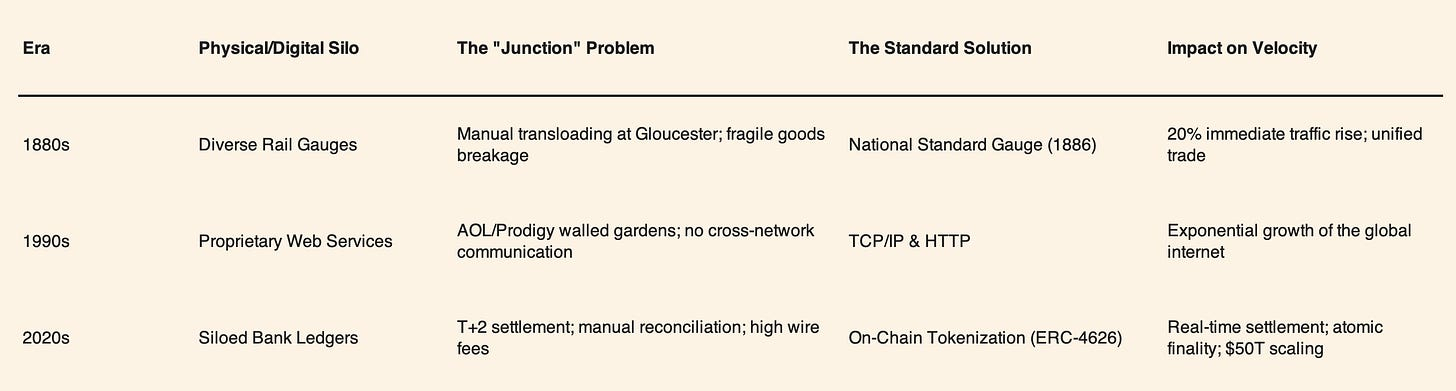
This physical friction is precisely analogous to the modern cost of clearing and settlement in TradFi. In the current system, every transaction must navigate a series of “transloading” events across siloed ledgers maintained by banks, clearinghouses, and central securities depositories.
The transition from T+2 to T+1 settlement in the United States and Canada represents an attempt to shorten this journey, but it does not remove the junction itself. Moving to T+1 reduces the time available for post-trade processing by roughly 80% for cross-border settlements due to the added complexity of time-zone and foreign exchange (FX) management.
Like the workers at Gloucester, modern back-office teams are sprinting to manually reconcile data across incompatible rails, a process that is increasingly untenable as transaction volumes and complexities rise.
The Southern US Two-Day Sprint of 1886
The solution to the Gloucester problem was not faster workers, but a unified standard. A profound demonstration of this occurred in the American South in May 1886. For decades, the Southern rail network had used a 5-foot gauge, incompatible with the Northern standard. Recognizing that this isolation was strangling economic growth, thousands of workers coordinated a “Two-Day Sprint” to manually adjust 13,000 miles of track to the national standard.
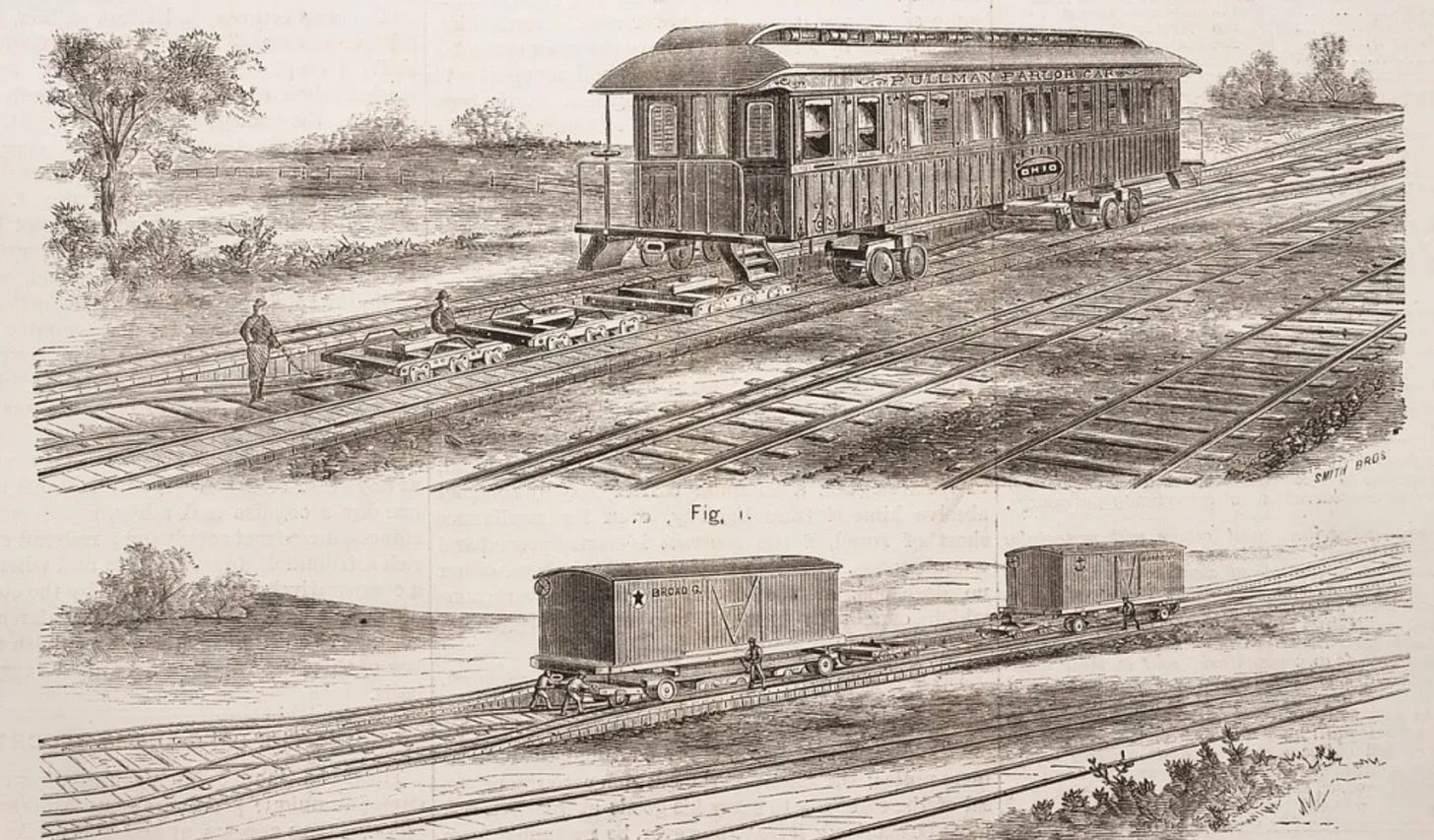
By Monday morning, trains rolled uninterrupted from the Atlantic to the Mississippi. The result was an immediate 20% increase in traffic as the friction of transloading was eliminated. This event serves as a historical proof of the “Unification Effect”: the transition to a common standard yields a century of frictionless progress that far outweighs the short-term cost of the transition.
The CorpChain Critique: Walled Gardens and Prettier Cages
In the modern context, many financial institutions are attempting to solve the friction problem by building private, permissioned blockchains—often referred to as “CorpChains.” However, these systems are fundamentally flawed because they preserve the “extraction” model. A private institutional blockchain is merely a “prettier cage”.
Like the proprietary walled gardens of AOL and Prodigy in the early days of the internet, CorpChains seek to maintain control over the junction rather than adopting an open protocol like TCP/IP.
History’s verdict on such systems is clear: they are eventually out-innovated and overwhelmed by open networks that cooperate on the underlying standard while competing on the product layer. A bank-owned ledger limits capital velocity because it requires every participant to seek permission and undergo vetting before they can innovate. In contrast, open networks trade this engineered stability for permissionless innovation, creating asymmetric outcomes and massive new value.
II. The Interface Revolution
The most significant economic breakthroughs in history have rarely been the result of a single “killer app.” Instead, they have come from the removal of friction via a common interface. When a standard interface is adopted, it allows disparate components of a system to connect seamlessly, turning physical assets into “software” that can be moved and reconfigured at will.
The Shipping Container (1956): Turning Logistics into Software
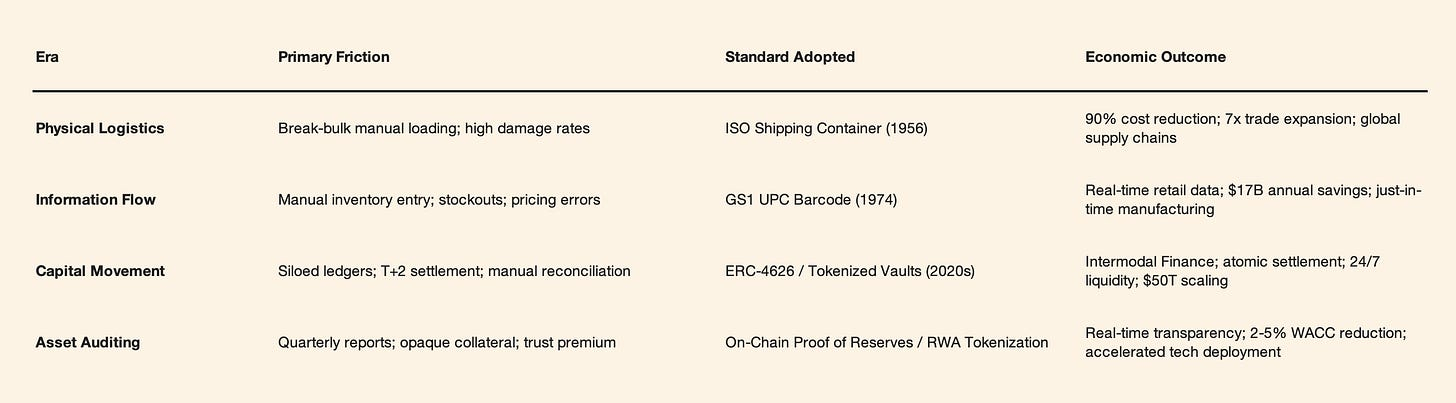
Before 1956, ocean shipping was an artisanal, “break-bulk” process. A typical shipment bound from Brooklyn to Germany might consist of 194,582 separate items arriving in 1,156 separate shipments. Stevedores had to manually stow these items, a process that was slow, expensive, and prone to theft and damage. Malcolm McLean, a truck driver, realized that the problem was not the ship, but the interface between the truck, the train, and the vessel.
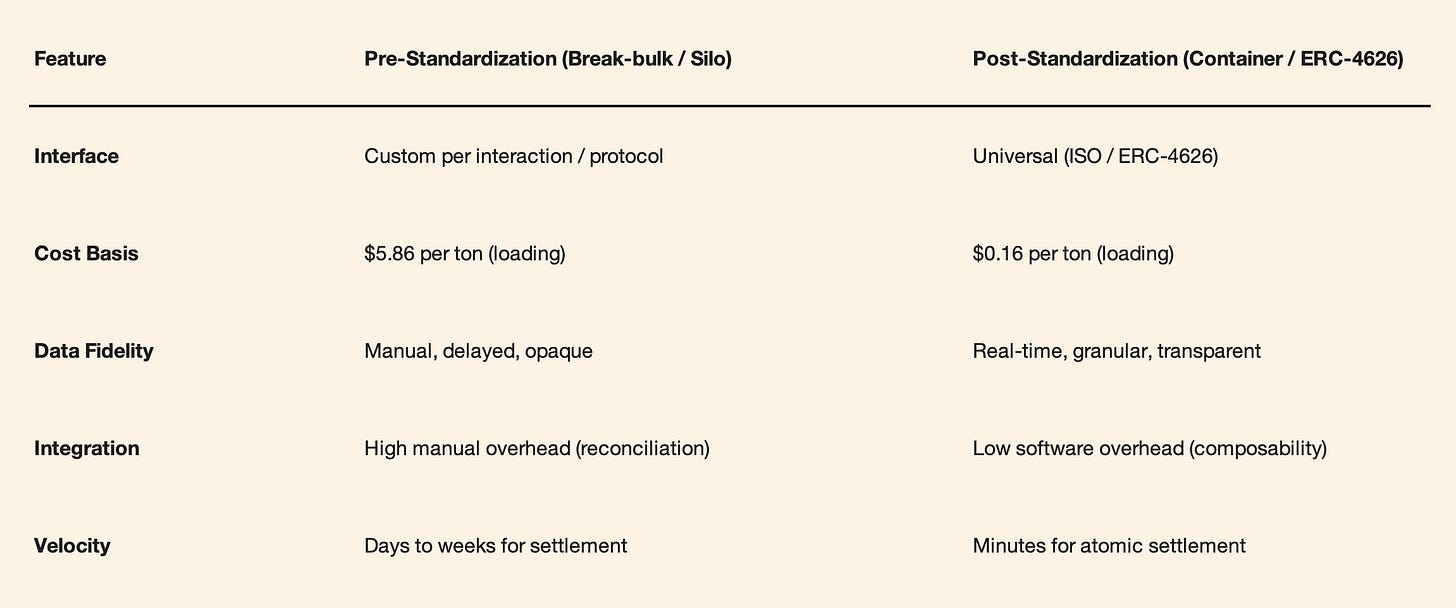
By developing the standardized shipping container—a “box” that could move seamlessly across modes of transport—McLean transformed the economics of global trade. The cost to load a ton of cargo dropped from $5.86 to $0.16, a staggering 97% reduction. McLean’s decision to make his patents royalty-free to the International Organization for Standardization (ISO) ensured that the container became an open protocol for global commerce.
This standardization allowed for “Intermodal Transport,” where the contents of a container are irrelevant to the logistics network; the network only cares about the “box.” Consequently, global trade expanded sevenfold within two decades.

ERC-4626: The “Shipping Container” for Yield
In the realm of on-chain finance, the ERC-4626 Tokenized Vault Standard represents the “Shipping Container” moment for capital. Before ERC-4626, every yield-bearing protocol (like Aave) used a unique architecture for its “vaults”. This meant that any developer wanting to build an aggregator, an insurance product, or a secondary market on top of these protocols had to write custom “transloading” code for each one. This fragmentation created massive friction and inhibited the growth of the decentralized finance (DeFi) ecosystem.
ERC-4626 provides a universal language for yield-bearing tokens, standardizing the interface for deposits, minting, withdrawals, and redemptions. This enables “Intermodal Finance”—the seamless movement of value between lending protocols, insurance pools, and liquid staking derivatives without the need for custom integrations. When every “vault” uses the same interface, capital can be automatically routed to its most productive use, significantly increasing the efficiency and liquidity of the global capital pool.
The UPC Barcode and the Universal Language of Collateral
The introduction of the UPC barcode in 1974 was the “standardized interface” for retail information. Before the barcode, inventory tracking was a manual, error-prone process that prevented real-time understanding of supply and demand. The barcode turned every physical item into a digital data stream, allowing retailers to automate checkouts, reduce shrinkage, and optimize supply chains.

Tokenization does for collateral what the barcode did for retail: it provides a “Universal Language” for assets. In TradFi, the quality and status of collateral are often opaque, requiring quarterly manual reports and complex audits. On-chain assets, however, are auditable in real-time through Proof of Reserves.
This transition from “static, paper-based trust” to “real-time, cryptographic verification” allows for a radical increase in the efficiency of collateral management. For the $50 trillion requirement, this means that real-world assets (RWA) such as bonds, real estate, and infrastructure can be fractionalized and traded with the same fluidity as software, removing the “liquidity discount” that currently plagues these asset classes.
III. The Permissionless Utility: The GPS Analogy
The expansion of the “Innovation Surface” is the ultimate byproduct of open standardization. When a top-down standard is opened for bottom-up innovation, it creates an economic surplus that the original creators could never have predicted. This is the difference between a “decreed order” (Roman Road) and an “emergent order” (Silk Road).
GPS as the Foundation for Unpredicted Industries
The Global Positioning System (GPS) was originally developed as a closed military tool. When the United States government decided to open the signal to the public, it transformed into a global public utility.
The creators of GPS could not have predicted that an open location standard would lead to the rise of precision agriculture, ride-sharing platforms like Uber, or the optimization of global power grids. These industries were built on top of the GPS “signal” because the standard was permissionless—any developer could “tune in” and build a product without signing a contract with the Department of Defense.
On-chain finance protocols like Aave, Uniswap, and the Ethereum base layer are the “GPS signals” for value. They provide a standardized, permissionless infrastructure that allows anyone to build financial products. In contrast, a Tier-1 Bank’s API is a gated entry point.
Even in the era of “Open Banking,” developers must undergo rigorous vetting, sign complex third-party relationships, and adhere to varying regional regulations like PSD2. The innovation surface of a bank’s API is limited by the bank’s internal roadmap and risk appetite, whereas the innovation surface of an open protocol is limited only by human ambition.
The Silk Road vs. The Roman Road
The “Open Networks” thesis relies on the distinction between two types of standards. The “Roman Road” model is a standard by decree—it is top-down, planned, and managed by a central authority. While efficient for the empire’s internal needs, it is rigid and vulnerable to the collapse of the center. The “Silk Road” model is a standard by consensus—it is an interlocking web of exchanges where no single ruler controls the gate.
On-chain finance operates on the Silk Road model. It is a “chaordic” system that trades engineered stability for a larger prize: permissionless innovation. This is why crypto protocols, despite being viewed as “toys” by traditional institutions in their early stages (much like Linux in the 1990s), eventually out-innovate the incumbents. Today, 90% of the cloud and the world’s top 500 supercomputers run on Linux. On-chain finance is following this same arc: moving from the periphery to becoming the indispensable operating system for human ambition.
Quantifying the Innovation Surface
The growth of open financial networks can be tracked through the volume of API calls and developer activity. Open banking API calls are projected to jump from 137 billion in 2025 to over 722 billion by 2029. However, these calls are still “intermediated” by traditional institutions. In the decentralized world, the innovation surface is measured by the “composability” of protocols. When a new standard like ERC-4626 is introduced, it creates an immediate explosion in compatible applications because every existing “box” can suddenly talk to every new “vault.”
IV. The Feedback Loop
The “Funding Abundance” thesis posits that open standards lead to a lower Weighted Average Cost of Capital (WACC), which in turn accelerates the deployment of technological solutions to global challenges. This creates a feedback loop: lower capital costs accelerate the learning curves of new technologies, which leads to further cost reductions and increased deployment.
The “Deflationary Arbitrage” of On-Chain Standards
In traditional finance, the cost of capital is inflated by a “Trust Premium” and an “Intermediation Premium.” Because ledgers are siloed and settlement is deferred, investors demand a higher return to compensate for the risk of counterparty failure, manual errors, and the lack of real-time transparency. On-chain standards reduce the WACC by replacing human-mediated trust with mathematical certainty.
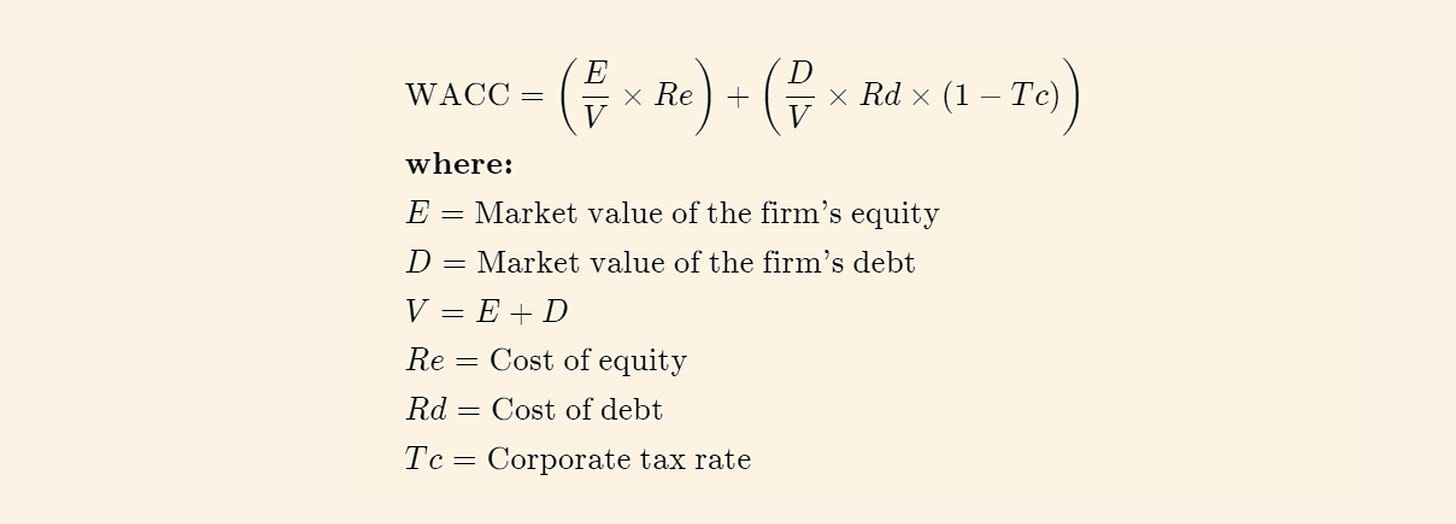
By providing a tool that reduces the cost of debt through better risk mitigation and transparent collateral, on-chain protocols can reduce the Rd for large-scale projects by 300 to 500 basis points. For a $50 trillion capital requirement, a 2% reduction in the global WACC represents $1 trillion in annual savings that can be reinvested into technological deployment. This is “Deflationary Arbitrage”—the process of extracting the “friction tax” from the financial system and reallocating it to productive use.
Swanson’s Law and the Acceleration Effect
Swanson’s Law states that for every doubling of cumulative installed solar capacity, the price of solar modules drops by 20%. This learning curve has seen solar prices fall from $76.67 per watt in 1977 to just $0.36 in 2014. Similar learning curves exist for battery storage, artificial intelligence, and robotics.
The critical insight for macro-strategists is how WACC reduction interacts with these learning curves. A lower cost of capital allows for faster deployment of capacity. According to the “Acceleration Effect,” if a 2% reduction in WACC causes the deployment of solar or robotics capacity to double every 3 years instead of every 4, the price of those technologies hits its “future cost target” significantly faster. This acceleration is essential for reaching the scale required to solve global energy and labor shortages within the next 25 years.
Financial Bandwidth and the Granularity Problem
The TradFi “pipes” were built for an era of large, infrequent, and centralized transactions. They cannot handle the granularity of the Abundance Era. As the world moves toward billions of micro-transactions (e.g., robots paying for their own electricity, micro-yield from fractionalized solar panels, AI agents trading data), the legacy system’s fee structure becomes a barrier.
A system that charges $20 for a wire transfer is fundamentally incompatible with a $0.05 micro-yield payment. On-chain networks, particularly Layer 2 solutions and high-throughput chains, provide the “Financial Bandwidth” necessary for this new reality. They allow for micro-yield and micro-transactions to settle with the same finality as a multi-billion dollar trade, providing a shared source of truth that is pseudonymous yet auditable.
V. Strategic Output Requirements: The Path Forward
To achieve the $50 trillion requirement, capital allocators must move beyond the “experimentation” phase of blockchain and into the “standardization” phase. The transition from a tax on ambition to an architecture of abundance requires a rigorous focus on open network alignment.
The “Tax on Ambition”: Quantification of Friction
The current payments and settlement landscape is burdened by “background radiation” friction that acts as a catalyst for on-chain migration.
- Merchant Fees: Over $187 billion is extracted annually in merchant fees alone, a direct tax on commerce that fuels centralized extraction models.
- Settlement Failure: The move to T+1 settlement exposes the fragility of manual processes, with an 80% reduction in time for FX and cross-border adjustments, leading to increased failed trades and liquidity gaps.
- Trust Premium: The lack of real-time auditability in traditional collateral management forces investors to maintain higher capital buffers, effectively “locking up” billions in unproductive liquidity.
On-chain migration converts these costs into “Economic Surplus.” By moving money at the speed of software, the $187 billion currently lost to fees and the billions lost to settlement delays are recaptured and put to work in funding the next era of infrastructure.
Conclusion: The Only Way to Scale
The $50T+ capital requirement of the next 25 years cannot be met by an infrastructure of “people and paperwork.” The legacy rails of traditional finance have reached their terminal velocity; adding more workers to the Gloucester transloading station will not stop the breakdown of the system. The only way to scale is to move the entire global capital stack onto a shared, standardized, and open architecture.
The synthesis of the “Open Networks” thesis with the “Funding Abundance” framework proves that standardization is not just a technical detail—it is the primary driver of economic surplus. By removing the interface friction of yield and collateral, and by opening the “GPS signal” for value to a global pool of developers, we can trigger an era of capital velocity that mirrors the growth of the internet.
The migration from T+2 to on-chain settlement, from siloed bank ledgers to standardized tokenized vaults, and from decreed order to emergent order is the defining macro-strategic shift of our time. The “Architecture of Abundance” is no longer a theoretical preference; it is the mathematical requirement for a world that seeks to fund its future. Those who build the open standards will inherit the $50 trillion opportunity; those who build “prettier cages” will be left behind at the break of the gauge.
Sources:
a16z cryptoWhy open networks winRead more5 months ago · 79 likes · 16 comments · Christian Catalini
- [https://stripe.com/en-ch/resources/more/on-chain-crypto-in-practice](https://stripe.com/en-ch/resources/more/on-chain-crypto-in-practice)
- https://www.library.hbs.edu/working-knowledge/the-truck-driver-who-reinvented-shipping](https://www.library.hbs.edu/working-knowledge/the-truck-driver-who-reinvented-shipping)[**Stani.eth**@StaniKulechovhttps://t.co/Ycaj8rVbjn5:58 PM · Feb 15, 2026 · 503K Views96 Replies · 136 Reposts · 1.07K Likes
Cover Artwork

The Basin of San Marco
Canaletto, c. 1738
Risk Disclaimer:
insights4.vc and its newsletter provide research and information for educational purposes only and should not be taken as any form of professional advice. We do not advocate for any investment actions, including buying, selling, or holding digital assets.
The content reflects only the writer’s views and not financial advice. Please conduct your own due diligence before engaging with cryptocurrencies or related technologies, as they carry high risks and values can fluctuate significantly.
Note: This research paper is not sponsored by any of the mentioned companies.