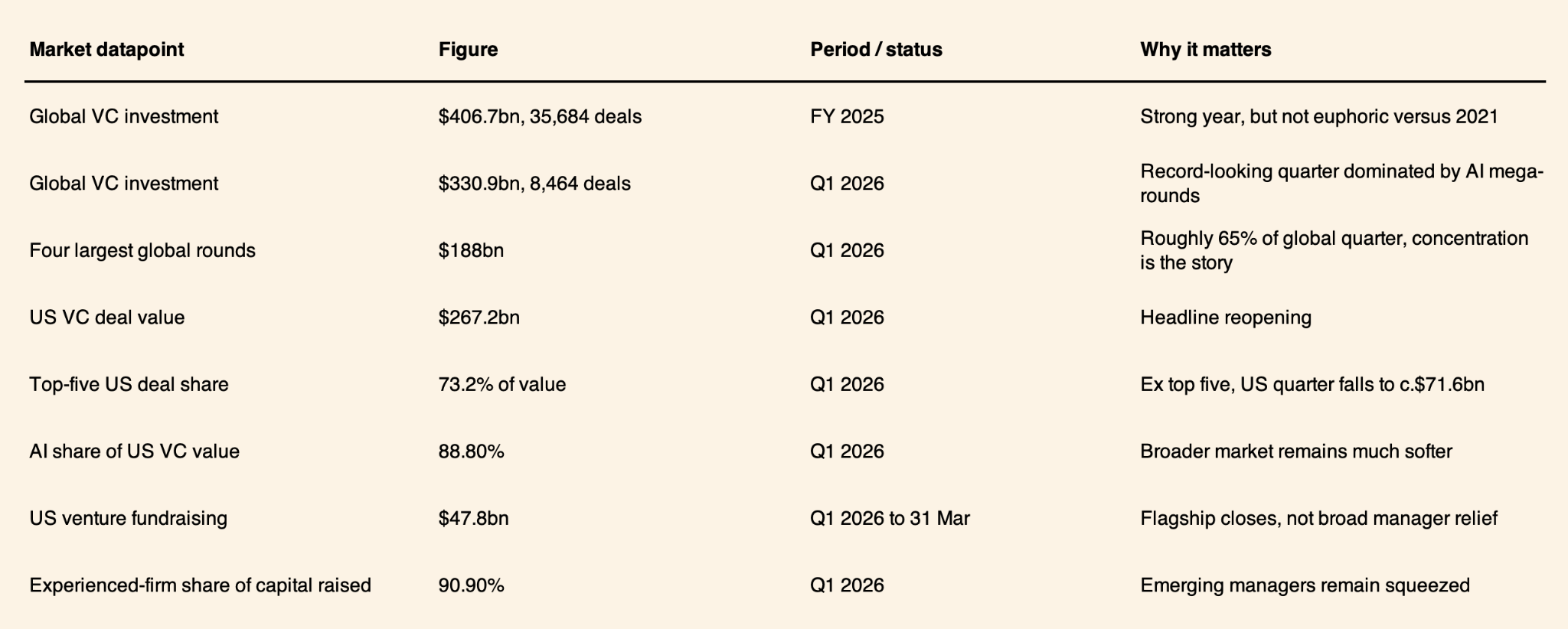
On 12 June 2026, SpaceX is set to test the strength of global risk appetite with the largest technology IPO in history. The company is seeking roughly $75 billion at a $1.75 trillion valuation, with reported demand exceeding $250 billion. Yet the scale of that single bookbuild risks creating a misleading picture of the broader capital environment. Venture deal value has also surged, while crypto firms are once again discussing billions of dollars in fresh dry powder, but the reopening remains unusually narrow. Global venture investment reached $330.9 billion across 8,464 deals in Q1 2026, yet OpenAI’s $122 billion round alone reshaped the quarter, while four mega-rounds absorbed approximately $188 billion, or roughly 65% of total funding.
The same tension defines crypto venture capital. The asset class is clearly no longer trapped in the 2023 to 2024 freeze, but the recovery is neither broad-based nor a replay of 2021. Capital is concentrating among larger managers, later-stage companies and financially legible infrastructure, particularly stablecoins, payments, prediction markets, tokenisation, onchain credit and compliance-intensive rails. The evidence for a new crypto VC supercycle is therefore strongest in capital concentration and institutionalisation, not in market breadth.
The signal from the broader venture market
The broader venture backdrop has improved in headline terms, but the headlines are unusually distorted. KPMG’s Q1 2026 global data show $330.9 billion invested across 8,464 deals, up sharply from $128.6 billion in Q4 2025; full-year 2025 global venture investment was $406.7 billion across 35,684 deals. In the US, PitchBook-NVCA recorded $267.2 billion of Q1 2026 deal value, a record quarter in practical terms, but top-five deal concentration reached 73.2% of value, and AI represented 88.8% of value while only 42.5% of deal count. Excluding the five largest US rounds, Q1 deal value would have been roughly $71.6 billion by simple arithmetic, which is respectable, but nowhere near a euphoric reopening.
Fundraising tells the same story. Global venture fundraising was $128.9 billion in 2025 and $58.4 billion in Q1 2026 annualised-to-date, while US venture fundraising stood at $47.8 billion in Q1 2026, helped by flagship closes rather than a broad thaw. PitchBook says experienced firms captured 90.9% of capital raised in Q1 2026, and median time to close stretched to 15.3 months. KPMG’s framing is similar: LPs are prioritising flagship funds, while smaller and emerging managers face a structurally harder market. That is not a classic risk-on cycle; it is a flight to brand, liquidity and mark-to-market credibility.
Macro still matters. The Federal Reserve kept the target range at 3.5% to 3.75% at its April 2026 meeting, and Reuters reported that most major brokerages had shifted towards expecting no US rate cuts in 2026. At the same time, Treasury yields had climbed from the spring lows, with the 10-year yield hitting 4.484% on 27 March, and AI-linked equities were selling off in early June amid concerns over stretched valuations and supply from mega-IPOs. Venture multiples can stay high if exits remain open, but they are being supported by a narrow set of public-market winners and by scarcity value in late-stage private names.
SpaceX is the best transmission mechanism for understanding the present cycle. As of the cutoff date, the offering was still expected to price on 11 June; nothing about pricing or aftermarket trading should be treated as complete. But the signal was already clear. If SpaceX clears at the proposed $75 billion size, it would create fresh LP distributions, reset the private-market cost of capital for scarcity assets and improve confidence for other giant issuers, including OpenAI and Anthropic, both of which had confidentially filed for US IPOs by early June. Circle’s June 2025 IPO, BitGo’s January 2026 NYSE debut, Figure’s 2025 registration statement and Blockchain.com’s May 2026 confidential filing all suggest that crypto and fintech names now have a more credible listing path than they did a year earlier. The risk is that one or two mega-IPOs reopen the narrative, not the market.
Crypto fund formation is reopening, but the money is clustering
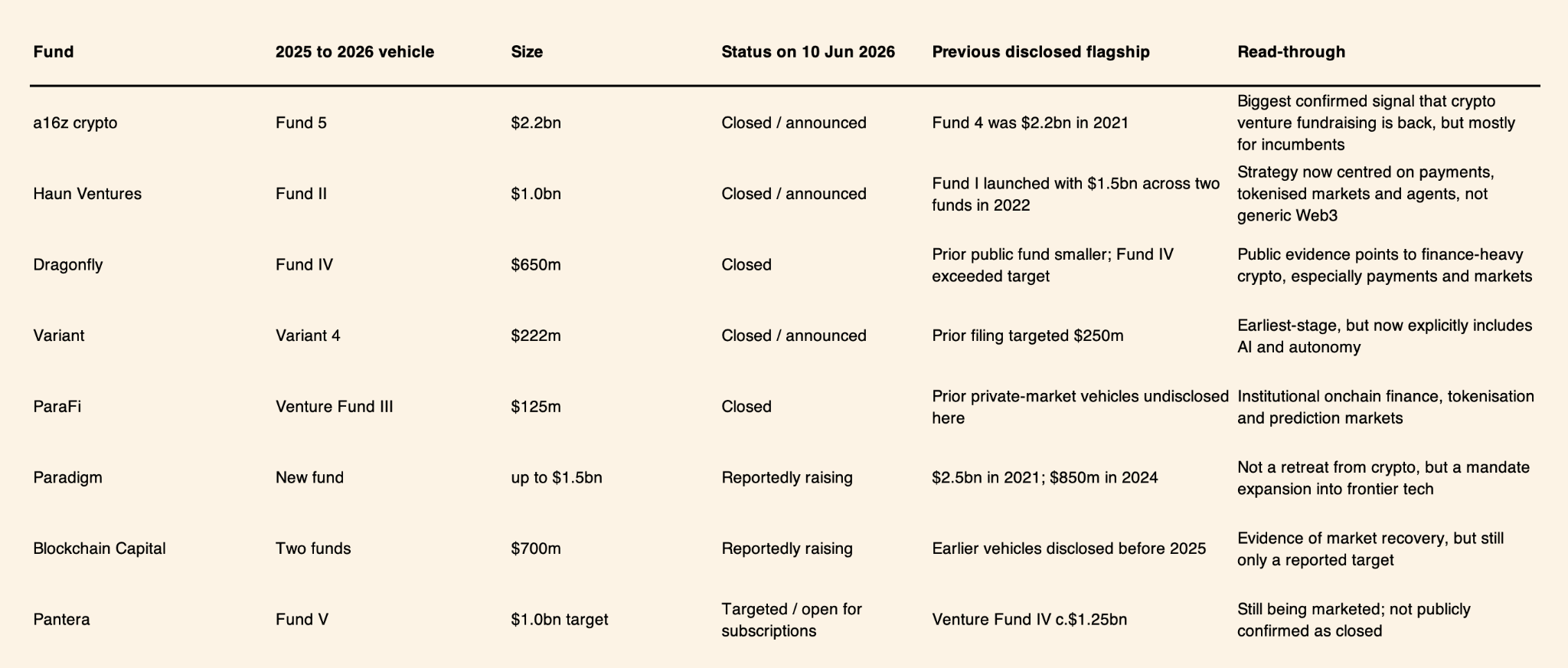
The strongest evidence for a new crypto capital cycle is not deployment breadth. It is fund formation among a small set of top brands. A16z crypto launched Fund 5 at $2.2 billion on 5 May 2026, explicitly arguing that stablecoins, onchain lending, tokenised assets, prediction markets, wallets and AI-agent transactions mark a phase in which crypto infrastructure is being turned into products people actually use. Haun Ventures announced $1 billion of new funds on 4 May 2026 around three themes: new financial infrastructure, new assets and markets, and the “agentic economy”. Dragonfly closed a $650 million fourth fund in February 2026. Variant announced a new $222 million Fund IV on 3 June 2026 around “autonomy”, expanding its earlier digital-ownership thesis into AI-agent and market infrastructure. ParaFi raised a $125 million venture fund in March 2026 and separately said it had raised another $325 million across other digital-asset strategies since the start of 2025.
That yields a high-confidence public total of roughly $4.2 billion of newly closed crypto-focused or crypto-adjacent venture capital by 10 June 2026, rising to roughly $4.5 billion if ParaFi’s non-venture digital-asset strategies are included. The pipeline is larger than the close count. Paradigm was reportedly raising up to $1.5 billion for a new frontier-tech fund spanning AI and robotics while continuing crypto; Blockchain Capital was reportedly seeking $700 million across two new funds; Pantera’s Fund V was still being marketed as an all-in-one blockchain vehicle with a $1 billion target and first-closing language carried on official Pantera materials. Combine those reported targets with confirmed closes and the headline “$6bn-plus race” is directionally correct. Combine only closed venture capital, and it is overstated.
The concentration is extreme. On confirmed closes alone, just five managers, a16z, Haun, Dragonfly, Variant and ParaFi, account for almost the entire public 2025 to 2026 crop. On the targeted pipeline, the top five names, a16z, Paradigm, Haun, Pantera and Blockchain Capital, represent about $6.4 billion. This is why the correct framing is that crypto venture is reopening for scaled franchises with track records, not for the median GP. Galaxy’s broader market data reinforce that point: only $1.98 billion was allocated to 11 new crypto venture funds in Q4 2025, and $1.1 billion to eight new funds in Q1 2026, the lowest quarterly fund count since Q3 2020.
Deployment has become a barbell
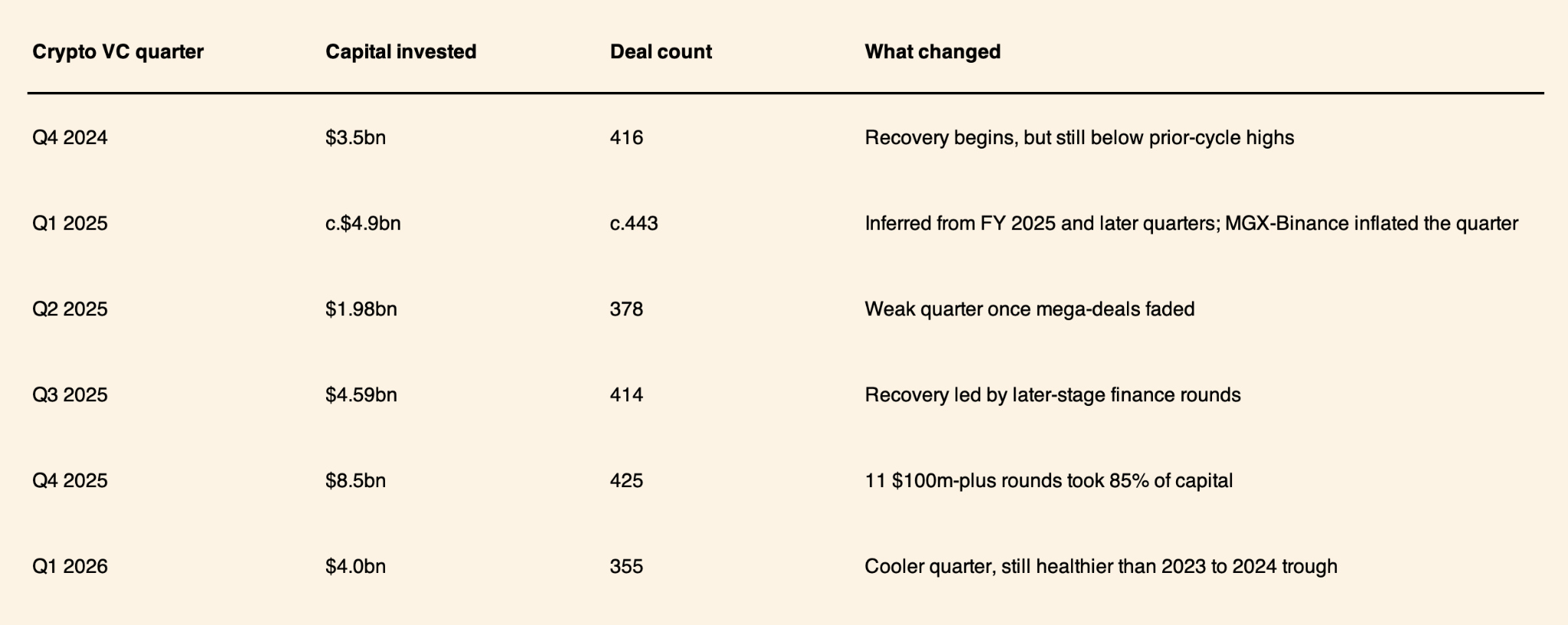
Galaxy’s quarter series is the cleanest public way to see what has changed. Crypto VC deployed $3.5 billion across 416 deals in Q4 2024; an inferred $4.9 billion across 443 deals in Q1 2025; $1.98 billion across 378 deals in Q2 2025; $4.59 billion across 414 deals in Q3 2025; $8.5 billion across 425 deals in Q4 2025; and $4.0 billion across 355 deals in Q1 2026. Full-year 2025 totalled about $20 billion across 1,660 deals, the highest annual tally since 2022 but still below the 2021 to early-2022 peak regime.
Crypto VC Capital Invested & Deal Count (Source: Galaxy Research)
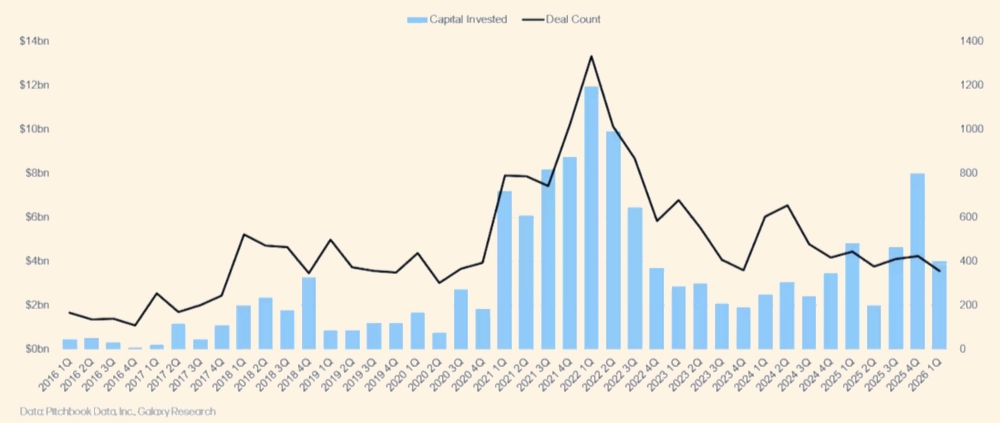
What matters more than the rebound is its composition. In Q4 2025, 11 rounds above $100 million absorbed 85% of all quarterly capital. In Q1 2026, later-stage companies captured 57% of invested capital, while pre-seed share of deal count fell to 19% and later-stage deals rose to one-quarter of completed rounds. Median crypto deal size reached a new high above $4.5 million in Q1 2026, while valuation data, sparse but directionally clear, stayed near cycle highs. The market is therefore barbelled: many early rounds still get done, but dollars aggregate around a small number of mature companies with revenue, licences or both.
Sector allocation has also rotated decisively from broad “Web3 adoption” towards financial crypto. In Q1 2026, Galaxy’s Trading/Exchange/Investing/Lending bucket took roughly $2.6 billion and 74 deals, by far the largest share of dollars and still the highest deal count. Infrastructure ranked second by deal count with 56 deals, while Web3/NFT/DAO/Metaverse/Gaming still produced 39 deals but much less capital. Tokenisation, payments/rewards, compliance, wallets and AI all remained active. In Q4 2025, the same financial bucket drew more than $5 billion, driven by later-stage rounds such as Revolut, Kraken and Rain. In other words, the categories receiving the largest cheques are stablecoin distribution, trading venues, wallets, market infrastructure and credit rails; the categories still attracting plenty of rounds but relatively little money are gaming, consumer Web3 and long-tail infrastructure.
What the big crypto funds now believe
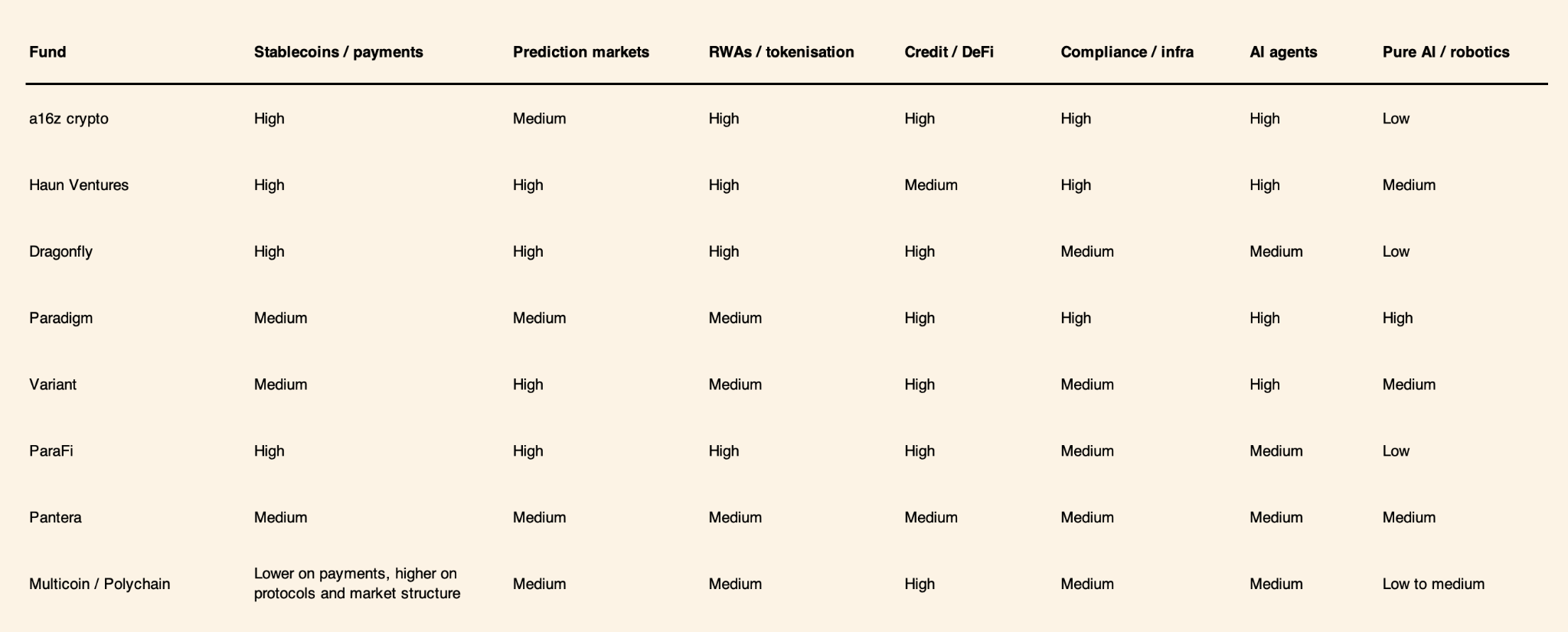
The common denominator across the largest managers is not “crypto is back”. It is “financial use cases are finally investable”. A16z Fund 5 is the clearest expression of the shift. Its own language is no longer about abstract protocol rails; it is about stablecoins, onchain finance, prediction markets, lending, tokenised assets, wallets and machine transactions. Haun is even more explicit that the opportunity sits across payments, banking, capital markets, identity and an “agentic economy”. Variant’s new autonomy frame broadens digital ownership into agentic systems, new markets and developer applications. Dragonfly’s public commentary and recent deal activity have leaned towards stablecoins, payments and prediction markets, not metaverse narratives. Paradigm is the outlier only in mandate breadth: it still backs crypto, but is reportedly raising a fund that can also buy AI and robotics exposure where the team sees technical overlap.
The strategic divide in 2026 is therefore between three models. First, crypto specialists staying narrow but moving from infrastructure to monetisable financial products; a16z and Dragonfly fit best. Second, crypto-plus-AI convergence funds arguing that autonomous software will need programmable money, identity and settlement; Haun and Variant fit here. Third, broader frontier-tech expansion, where crypto is one important pillar but not the whole mandate; Paradigm is the most credible example. On present evidence, the first two strategies appear better aligned with actual deployment than a full pivot into pure AI.
Thesis heatmap, June 2026, based on public theses and disclosed investments
The cost-of-trust test explains why capital is clustering
The common denominator across stablecoins, prediction markets, onchain credit and tokenisation is not simply that they are financial applications. Each targets an activity in which trust is expensive, exclusionary or structurally difficult for legacy infrastructure to provide. This distinction matters because it offers a more rigorous explanation for why institutional capital is concentrating in these categories while remaining cautious towards much of consumer crypto.
1kx’s June 2026 Cost of Trust 2.0 thesis provides a useful framework. Its original 2018 thesis argued that blockchains could contest approximately $29 trillion of economic activity associated with maintaining records, enforcing agreements, safeguarding assets and verifying ownership. The updated thesis asks a narrower and more investable question: within that addressable surface, which configurations can actually capture venture-scale value? Its answer is that durable outcomes tend to emerge through one of two mechanisms, and that the strongest businesses combine both.
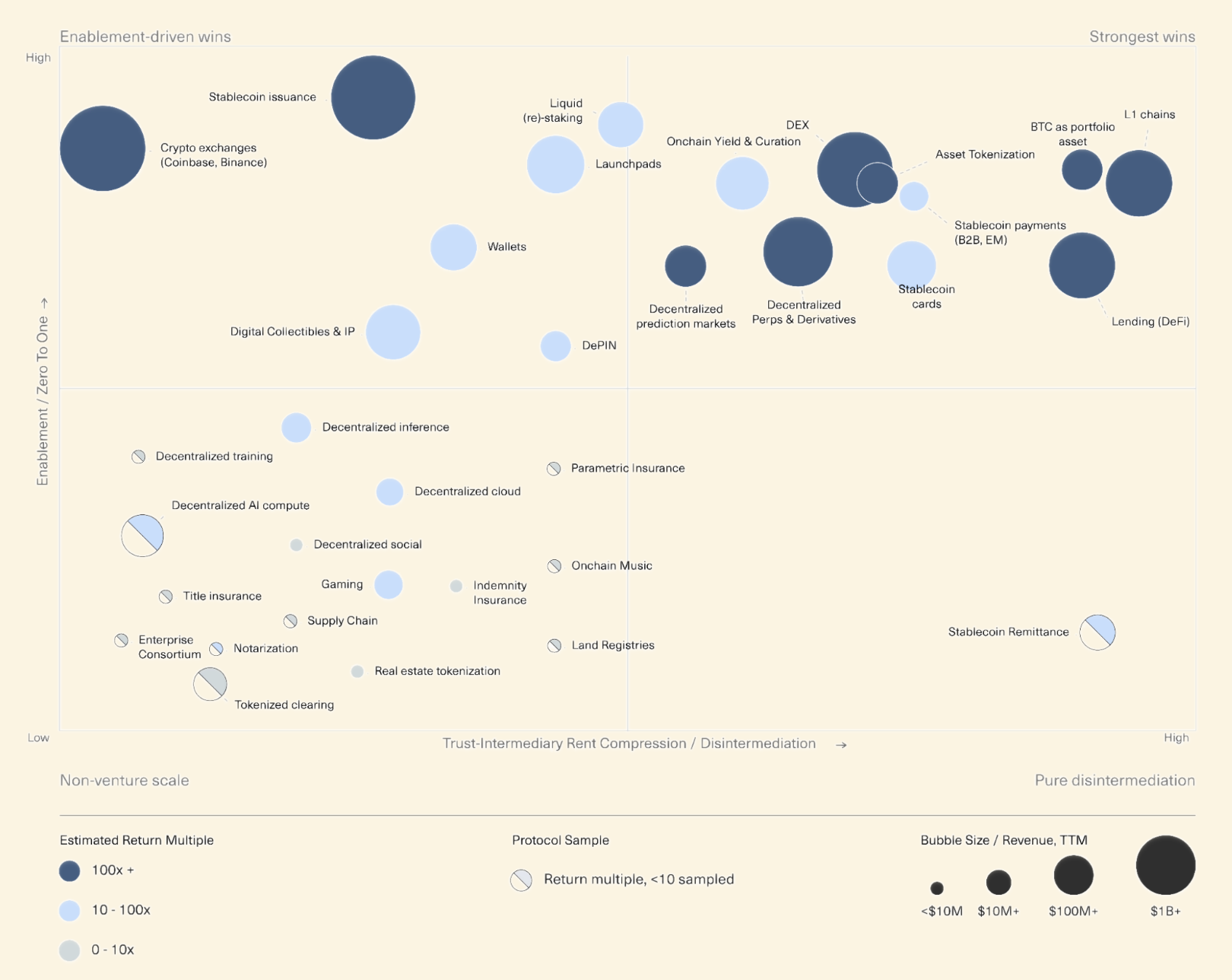
The first mechanism is trust-intermediary rent compression. Financial systems pay banks, custodians, brokers, exchanges, payment processors and other trusted institutions through fees, spreads, settlement delays, capital requirements and operational overhead. An onchain system creates economic value when it can deliver the same trust outcome at lower cost, turning the incumbent intermediary’s economic rent into an addressable market.
The second mechanism is enablement, or zero-to-one market creation. Here, blockchain does not merely provide a cheaper version of an existing service. It makes possible a product, market or form of participation that legacy infrastructure cannot reliably offer because of jurisdictional restrictions, closed operating hours, fragmented counterparties, lack of programmability or limited access. According to the 1kx framework, the largest historical outcomes have generally combined meaningful rent compression with a new form of market access or functionality.
Four blockchain properties support these mechanisms. Programmable bearer settlement allows value to move natively as data. Verifiable computation and state allow solvency, ownership and transaction history to be inspected rather than merely asserted. Structural neutrality reduces the risk that a platform operator changes the rules or competes with participants. Permissionless participation allows users and developers to enter without requiring approval from a central gatekeeper. The first two properties primarily reduce the cost of existing trust arrangements; the latter two create products and markets that a jurisdictionally bounded institution may be unable to operate.
This framework helps explain the present investment cycle.
Stablecoin payments can compress the cost and delay associated with correspondent banking, prefunding and cross-border settlement. Their larger opportunity, however, is often enablement: continuous dollar access, programmable treasury operations and global payment accounts for users and companies that cannot efficiently access the US banking system. The stablecoin itself may become commoditised, while durable value accrues to the wallet, card, treasury, compliance or credit layer controlling distribution.
Prediction markets can reduce the economic margins captured by bookmakers and centralised trading venues, but their more distinctive feature is the creation of globally accessible markets around events that regulated exchanges may not approve quickly enough, or at all. Polymarket therefore represents a stronger example of permissionless enablement, while Kalshi demonstrates how licensing and regulated distribution can create a defensible centralised business around similar demand. The comparison also shows that blockchain is not automatically necessary for every prediction venue. Its relevance increases when global participation, open market creation and neutral settlement are load-bearing rather than incidental.
Onchain credit combines both mechanisms more clearly. It can reduce administration, intermediation and settlement costs, while enabling programmable collateral, continuously visible positions, automated liquidation and the use of one financial position inside another application. Morpho’s institutional relevance comes not merely from offering loans onchain, but from becoming an embedded credit layer that exchanges, wallets and asset managers can integrate into their own products.
Tokenization requires a more selective interpretation. Wrapping an offchain security in a token may improve distribution or settlement, but it does not necessarily create a lasting blockchain-native advantage. The more defensible opportunity lies in assets that are issued natively onchain and can function as programmable, continuously settling collateral. 1kx similarly distinguishes between tokenised wrappers that incumbents can readily absorb and native instruments that remove transfer agents, settlement float and other components of the traditional securities stack.
The same test also helps identify weaker investments. A product may use tokens, wallets or smart contracts without solving a material trust problem. Where the blockchain is merely a distribution device, the product could have been built using a conventional database, and neither meaningful rent compression nor structural enablement is present. This helps explain why generic consumer Web3, undifferentiated gaming projects and many enterprise blockchain deployments have struggled to produce outcomes comparable with exchanges, stablecoin infrastructure or onchain financial protocols.
The framework does not imply that value accrues exclusively to decentralized protocols. 1kx’s own retrospective argues that open-source systems have been strongest at the trust-bearing protocol layer, while closed-source companies have frequently captured value through usability, compliance and distribution. Coinbase, regulated custodians, wallets and stablecoin infrastructure companies can therefore produce major equity outcomes even when the underlying settlement layer is open.
That observation is especially relevant to the present market. Rain and Kalshi are not decentralized protocols, but they sit directly above new trust and settlement infrastructure, packaging it into products that enterprises and regulated users can adopt. Morpho sits closer to the open protocol layer, while Polymarket combines an open settlement architecture with a recognisable consumer interface. The four companies therefore represent different points in the same value stack, rather than one uniform model of crypto investment.
The cost-of-trust framework also sharpens the crypto and AI discussion. 1kx argues that AI creates new trust surfaces because generative systems reduce the cost of producing convincing false identities, communications and content, while autonomous agents require access to money, accounts and services. The investable opening is not simply to attach tokens to AI products. It is to build verifiable identity, provenance, permissioning and settlement infrastructure where trust is the binding constraint. Agent payments and sovereign machine wallets may represent genuine enablement markets, but they remain substantially earlier than stablecoins, trading or onchain credit.
For investors, the resulting diligence test is more demanding than asking whether a company participates in a popular crypto sector. The relevant questions are: which exact trust cost is being removed, who currently captures that rent, why blockchain is necessary to reduce it, what can now be created that legacy infrastructure cannot provide, and where value ultimately accrues once incumbents adopt the same rails. A startup with no clear answer may still achieve short-term growth, but its blockchain component is unlikely to constitute a durable moat.
The framework should nevertheless be treated as an investment lens rather than independent proof. It is a self-authored fund thesis based partly on 1kx’s portfolio, internal categorisation and point-in-time marks. The firm states that its performance examples are illustrative, unaudited and not representative of complete fund performance. Its value to this paper lies in the quality of the questions it introduces, not in treating its historical classifications as definitive evidence.
The central implication is that capital is not clustering around financial crypto by coincidence. It is moving towards markets where trust remains expensive, where usage can be measured through real flows, and where programmability or permissionless access produces something the incumbent system cannot easily replicate. That strengthens the paper’s broader conclusion: the current crypto VC recovery is selective because the investable opportunity is increasingly defined by economic mechanisms, not by token categories.
Four company case studies show where conviction capital is going
Kalshi
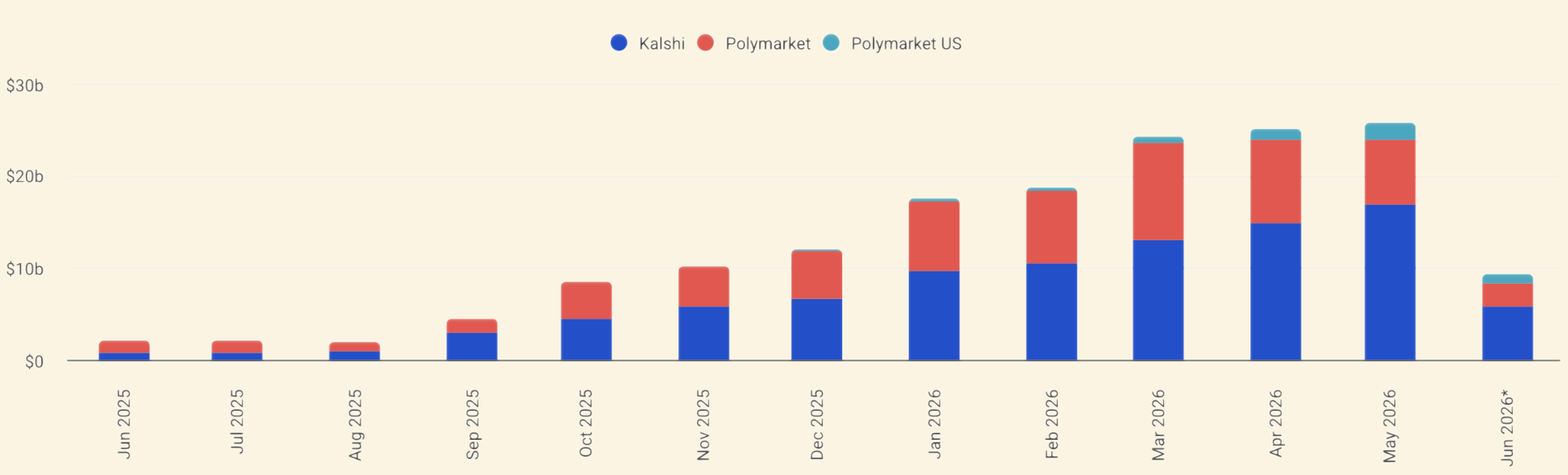
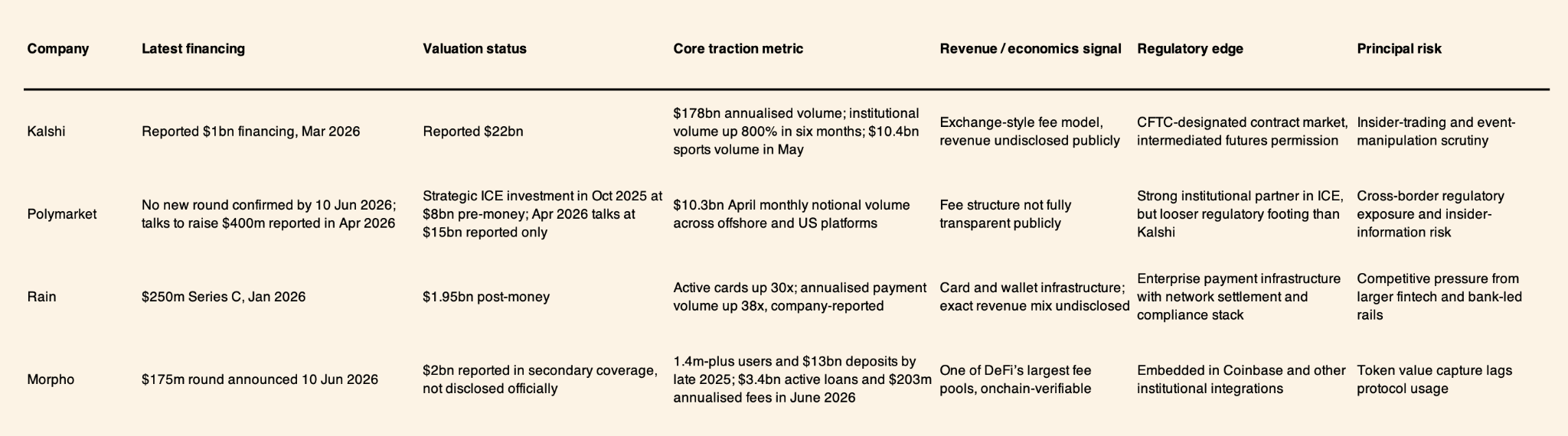
Kalshi is the only major US prediction-market platform with a clear federal regulatory moat. The CFTC designated KalshiEX as a contract market in 2020, and the agency’s filing log shows a January 2025 modification allowing intermediated futures trading. That regulatory status is now translating into institutional relevance. In March Kalshi had raised about $1 billion in new financing at a reported $22 billion valuation, after a December financing that valued it at $11 billion; annualised trading volume had risen to $178 billion and that institutional trading volume had grown 800% in six months.
Company materials published in May said Kalshi was handling over 90% of US prediction-market activity, while Barron’s reported $10.4 billion of sports trading volume in May alone. The investor case is straightforward: a federally regulated event market can move from politics into sports, macro, commodities and enterprise hedging. The risks are equally clear. Prediction markets are now attracting insider-trading scrutiny, and Kalshi has had to add new compliance controls in June 2026 after suspicious-trading concerns. Kalshi’s long-term question is not whether there is demand, but whether high-velocity event trading can remain clean enough, and broad enough beyond election cycles, to justify exchange-like multiples.
Polymarket, Polymarket US and Kalshi Volume (Monthly), Source: TheBlock
Polymarket
Polymarket remains the category’s global information market, but with more legal ambiguity than Kalshi. The company paid a CFTC penalty in 2022 for operating an unregistered derivatives platform, after which US access was curtailed; by October 2025, ICE announced a strategic investment of up to $2 billion, valuing Polymarket at about $8 billion pre-money and pairing the platform’s event data with a mainstream market operator. By April 2026, Reuters reported that Polymarket was in talks to raise $400 million at about a $15 billion valuation, but that financing was only reported, not closed, as of the cutoff date.
On activity, Dune Analytics showing roughly $10.3 billion of monthly notional volume across Polymarket’s offshore exchange and US platform in April 2026, versus $3.8 billion a year earlier. In May Polymarket was launching markets tied to private-company milestones, explicitly pitching them as price-discovery tools for institutional investors.
That is the bull case: Polymarket could become a global event-data layer, not merely a crypto-native betting app. The bear case is that the platform still sits closer to a regulatory grey zone, particularly around manipulation, insider information and cross-border enforceability, and that its latest valuation chatter is ahead of a completed financing.
Rain
Rain is one of the clearest examples of capital moving from stablecoin issuance to stablecoin distribution. Reuters reported in January 2026 that Rain raised a $250 million Series C led by ICONIQ at a $1.95 billion valuation, bringing total funding above $338 million. Rain’s product is not a stablecoin; it is enterprise infrastructure for issuing and managing stablecoin-linked payment cards and wallets, usable where Visa is accepted. The company said active cards had grown 30 times year on year and annualised payment volume 38 times, both company-reported rather than independently audited in public. Rain’s own website emphasises daily onchain settlement with card networks, compliance and programme operations, and the ability to launch cross-border card programmes without stitching together separate local issuers and vendors.
The reason investors care is that distribution is where network effects can become durable: enterprise card issuance, treasury flows and consumer spending are harder to displace than simply minting one more dollar-backed token. The chief risk is competitive intensity. Exact market shares versus Bridge, BVNK, Stripe and bank-led alternatives are not yet public, and much of Rain’s traction is relative rather than absolute. Still, Rain is precisely the kind of regulated, revenue-adjacent infrastructure asset that fits the new crypto VC playbook.
Morpho
Morpho is the best evidence that onchain credit is moving from crypto-native leverage into reusable financial infrastructure. In its January 2026 “Morpho 2026” review, the project said usage had grown from 67,000 users to more than 1.4 million, deposits from $5 billion to $13 billion, and active loans to $4.5 billion by late 2025; it also highlighted integrations with Coinbase, Crypto.com, Gemini and Société Générale Forge. As of June 2026, DefiLlama showed active loans of about $3.4 billion and annualised protocol fees above $200 million, making Morpho one of the most economically significant onchain lending systems.
On 10 June 2026, Morpho Association officially announced a $175 million round co-led by Paradigm, a16z crypto and Ribbit, with strategic participation from Apollo Funds, Circle Ventures and others. Secondary coverage put the valuation at about $2 billion, though Morpho’s own announcement did not disclose a valuation and that distinction matters. The bull case is strong: Morpho is increasingly the embedded lending layer for exchanges, wallets and institutional products, rather than merely another retail lending app. The principal risk is value capture. Protocol usage is clearly real and onchain-verifiable; the long-term relationship between that usage, governance and sustainable tokenholder economics is less settled.
What the market is telling us
Capital is moving towards applications with infrastructure economics, not infrastructure for its own sake. The winners are businesses that sit close to flows, fees, compliance and distribution. That is why stablecoin rails, wallets, onchain credit, prediction venues and tokenisation tooling are winning both the largest rounds and the most serious institutional conversations.
Investors are also prioritising measurable usage over token optionality. In 2021, “crypto VC” often meant underwriting future token appreciation and broad consumer adoption. In 2026 it increasingly means underwriting transaction growth, licensed market access, enterprise distribution and whether a company can become part of financial plumbing. Rain and Morpho fit that model. Kalshi and Polymarket fit it when they behave more like exchanges and information markets than like casinos.
Stablecoins are, in practice, becoming the main venture entry point into crypto. Not because issuance itself is the best business, but because it unlocks adjacent revenue pools in payments, card programmes, wallets, FX, treasury and credit. Prediction markets are becoming a genuine financial category, though one with political and compliance risk that still deserves a discount. Onchain credit is now credible for institutions where compliance, custody and distribution are solved by recognisable partners, but tokenholder value accrual and regulatory perimeter questions remain unsettled.
The underfunded middle is still the post-seed, pre-scale company that is neither a toy consumer app nor a revenue-bearing platform. The overfunded parts of the market are the late-stage scarcity names and anything that can plausibly tell an AI-convergence story. Founders building consumer crypto, gaming, generic L1 poverty alleviation pitches or undifferentiated token products still face a much harsher market than the aggregate data imply.
The crypto-to-AI pivot is real, but only partly about leaving crypto
The strongest evidence does not show crypto VCs abandoning crypto. It shows them hedging two realities at once. First, AI offers larger total addressable markets, stronger LP demand and a nearer exit path. Second, certain AI use cases genuinely require the things crypto is unusually good at, programmable payments, persistent identity, machine wallets, auditability and open settlement. That is why Paradigm’s reported new fund broadens into AI and robotics without dropping crypto, why Haun explicitly talks about an agentic economy, and why Variant has reframed its thesis around autonomy rather than token categories.
The strongest investable convergence themes are narrow. One is agent payments and machine commerce, where autonomous software needs native ways to pay for compute, data, APIs and services. Another is identity, verification and policy tooling for agents, because autonomous systems need permissioning, provenance and fraud controls. A third is AI-enabled compliance and security, especially where open financial systems require automated monitoring. These all sit naturally next to stablecoins, wallets and market infrastructure.
The weakest themes are the ones using AI mainly as a marketing wrapper around old token narratives, most decentralised-compute pitches without a real customer, many “AI agents as memecoins” experiments, and frontier-tech diversification that lacks a clear bridge back to the manager’s actual edge. The difference between a credible convergence strategy and a narrative pivot is whether the fund can point to concrete investments or infrastructure work, not just blog-post language. On that test, Haun, Variant and Paradigm look more serious than funds that have merely updated their websites.
Judgement and takeaways
Crypto venture capital is entering a new capital cycle, but not a broad-based supercycle. The recovery is real in three senses: top-tier managers can raise again; later-stage crypto-financial companies can attract large rounds at premium valuations; and public-market optionality for crypto and fintech issuers is materially better than it was in 2023 or 2024. But the breadth thesis is weaker. Deployment remains barbelled, fund formation is concentrated and many early-stage segments still do not clear institutional diligence unless they are tied to measurable flows or defensible market access.
So, is crypto VC entering a genuine new supercycle? Not yet. It is entering a narrower, more institutional and more financially legible cycle. The dominant opportunity set has shifted from generalised blockchain adoption towards financial infrastructure with clear usage, especially stablecoins, payments, prediction markets, tokenisation, credit and compliance. Valuations are not uniformly attractive; they are often expensive for the best companies and still difficult for the undifferentiated middle. AI strengthens the thesis where autonomous systems need money, identity, settlement or risk controls. Pure AI diversification, by contrast, dilutes a crypto-specific edge unless the manager can demonstrate one.
The most durable institutional-scale outcomes are likely to come from businesses that become part of financial plumbing, not from speculative token narratives. That includes stablecoin distribution, regulated event markets, embedded onchain credit, tokenised-asset infrastructure, compliant wallets and market-adjacent data or risk tools. The bullish thesis would be invalidated if the IPO window proves illusory, if rates stay restrictive enough to compress late-stage multiples, if stablecoin regulation fragments rather than clarifies, or if the prediction-market boom turns into a regulatory backlash rather than a new asset class.
What the capital is telling us
Capital no longer rewards crypto just for being crypto. It is rewarding companies that can prove they move money, clear transactions, satisfy regulators or embed themselves in institutional workflows.
Stablecoins are becoming the central venture beachhead into onchain finance. The largest opportunity may not be who issues the token, but who controls the wallet, card, treasury, checkout or lending surface around it.
Prediction markets have graduated from novelty to investable category, but they are still politically fragile. Their upside now depends as much on surveillance, market integrity and licensing as on user growth.
Onchain credit is becoming institutionally credible because it is being distributed by recognisable names. That gives protocols like Morpho a real shot at infrastructure status, but it does not automatically solve value capture for tokens.
The next leg of crypto venture will be decided by exits, not slogans. If SpaceX and the broader IPO queue hold, crypto VC can keep compounding; if the window narrows again, today’s “supercycle” will look more like a selective repricing of a few exceptional businesses.
Source
- PitchBook-NVCA Venture Monitor, Q1 2026
- KPMG Venture Pulse, Q1 2026 Global Report
- 1kx, Cost of Trust 2.0
- Galaxy Research, Crypto and Blockchain Venture Capital Q1 2026